Discover Recipes
Explore recipes from our community
Filter by health condition
Show recipes containing compounds recommended for these conditions.
Cardiovascular
Digestive
Endocrine
Musculoskeletal
Oral Health
Psychiatric
Renal
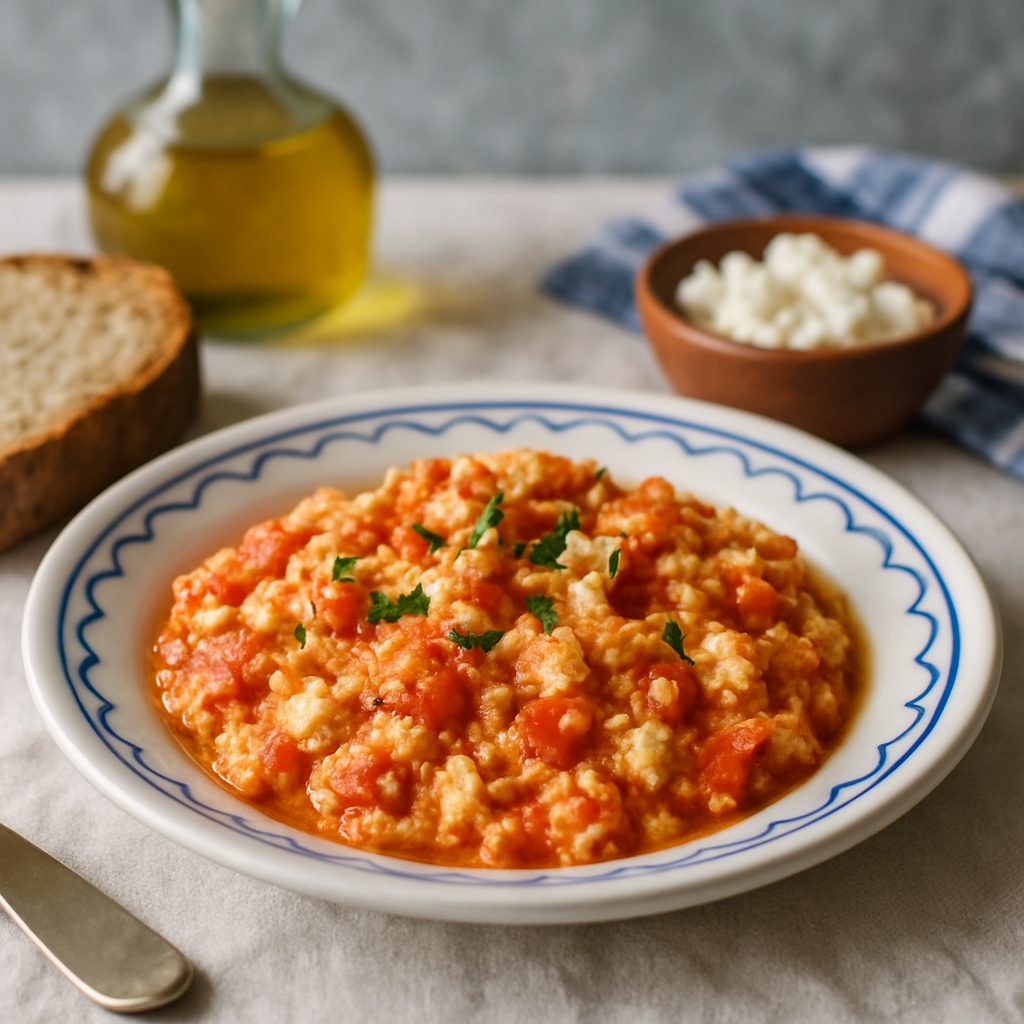
Strapatsada
Strapatsada is a Greek dish of scrambled eggs cooked with fresh tomatoes, onion, and crumbled feta. It's soft, savory, and a little tangy from the cheese. Greeks eat it for breakfast or a light supper, usually with bread to mop up the juices. #Greek #eggs #vegetarian #breakfast #tomato #Mediterranean
22
min total
(Prep:
10
| Cook: 12)
2
servings

Eggs, Grade A, Large, egg whole
4.0 gram
Tomato, roma
300.0 gram
Olive oil
3.0 1 tablespoon
Onions, white, raw
100.0 gram
Salt, table
0.25 tsp
Spices, oregano, dried
0.5 g
Spices, pepper, black
0.25 g
Cheese, feta
2.0 g
Nutrition Facts
Energy
684.0 kilocalorie
Protein
14.5 gram
Myristoleic acid (C14:1)
0.0 gram
Pentadecenoic acid (C15:1)
0.0 gram
Palmitoleic acid (C16:1, Omega-7)
0.7 gram
Heptadecenoic acid (C17:1)
0.0 gram
Gondoic acid (C20:1, Omega-9)
0.1 gram
Erucic acid (C22:1, Omega-9)
0.0 gram
Nervonic acid (C24:1, Omega-9)
0.0 gram
Oleic acid (C18:1, Omega-9)
31.2 gram
Alpha-Linolenic acid (ALA) (C18:3, Omega-3)
0.0 gram
Docosahexaenoic acid (DHA) (C22:6, Omega-3)
0.0 gram
Eicosapentaenoic acid (EPA) (C20:5, Omega-3)
0.0 gram
Pufa 2:5 N-3 (epa)
0.0 gram
Linoleic acid (C18:2, Omega-6)
0.1 gram
Gamma-Linolenic acid (GLA) (C18:3, Omega-6)
0.0 gram
Stearidonic acid (SDA) (C18:4, Omega-3)
0.0 gram
Eicosadienoic acid (C20:2, Omega-6)
0.0 gram
Dihomo-gamma-linolenic acid (DGLA) (C20:3, Omega-6)
0.0 gram
Arachidonic acid (ARA) (C20:4, Omega-6)
0.0 gram
Docosapentaenoic acid (DPA) (C22:5, Omega-3)
0.0 gram
Palmitic acid (C16:0)
8.8 gram
Capric acid (C10:0)
1.4 gram
Lauric acid (C12:0)
0.8 gram
Tridecylic acid (C13:0)
0.0 gram
Myristic acid (C14:0)
1.9 gram
Pentadecylic acid (C15:0)
0.0 gram
Margaric acid (C17:0)
0.0 gram
Arachidic acid (C20:0)
0.0 gram
Behenic acid (C22:0)
0.0 gram
Lignoceric acid (C24:0)
0.0 gram
Butyric acid (C4:0)
0.5 gram
Caproic acid (C6:0)
0.4 gram
Caprylic acid (C8:0)
0.4 gram
Stearic acid (C18:0)
2.2 gram
Trans Fat
0.0 gram
Dietary Fiber
4.9 gram
Starch
0.0 gram
Lactose
0.0 gram
Maltose
0.0 gram
Sucrose
0.6 gram
Fructose
2.5 gram
Galactose
0.0 gram
Glucose
2.7 gram
Carotene, Alpha
3.0 microgram
Carotene, Beta
844.7 microgram
Choline
39.1 milligram
Folate (Vitamin B9)
113.0 microgram
Retinol
102.2 microgram
Vitamin A
520.6 microgram
Vitamin B-12
1.3 microgram
Vitamin B-12, Added
0.0 microgram
Vitamin B-6
0.6 milligram
Vitamin B1 (Thiamin)
0.3 milligram
Vitamin B2 (Riboflavin)
0.7 milligram
Vitamin B3 (Niacin)
2.4 milligram
Vitamin B5 (Pantothenic Acid)
0.8 milligram
Vitamin B7 (Biotin)
1.4 microgram
Vitamin C
53.4 milligram
Vitamin D
16.9 International Unit
Vitamin E
9.1 milligram
Vitamin K
20.7 microgram
Vitamins And Other Components
0.0 gram
Calcium, Ca
450.3 milligram
Copper, Cu
0.2 milligram
Iron, Fe
1.8 milligram
Magnesium, Mg
53.9 milligram
Manganese, Mn
0.6 milligram
Phosphorus, P
353.8 milligram
Potassium, K
807.2 milligram
Selenium, Se
12.8 microgram
Sodium, Na
1456.2 milligram
Zinc, Zn
2.7 milligram
25-hydroxycholecalciferol
0.0 microgram
ALA (Alpha-Linolenic Acid, Omega-3)
1.1 gram
Alcohol, Ethyl
0.0 gram
Amino Acids
0.0 gram
Arginine
0.4 gram
Ash
6.6 gram
Aspartic Acid
0.7 gram
Betaine
0.3 milligram
Caffeine
0.0 milligram
Carotene, Gamma
6.4 microgram
Cholesterol
84.1 milligram
Cis-beta-carotene
0.0 microgram
Cis-lutein/zeaxanthin
2.3 microgram
Cis-lycopene
0.0 microgram
Cryptoxanthin, Alpha
29.4 microgram
Cryptoxanthin, Beta
58.3 microgram
Cysteine
0.0 gram
Cystine
0.1 gram
Fluoride, F
0.6 microgram
Folic Acid
0.0 microgram
Glutamic Acid
1.9 gram
Glycine
0.1 gram
Histidine
0.3 gram
Hydroxyproline
0.0 gram
Iodine, I
2.0 microgram
Isoleucine
0.6 gram
Leucine
1.1 gram
Lipids
0.0 gram
Lutein
177.2 microgram
Lutein + Zeaxanthin
192.9 microgram
Lycopene
8580.3 microgram
Lysine
1.0 gram
Methionine
0.3 gram
Nitrogen
0.6 gram
Oleic Acid (Omega-9)
0.0 gram
Phytosterols
3.4 milligram
Proline
1.1 gram
Proximates
0.0 gram
Serine
0.9 gram
Theobromine
0.0 milligram
Threonine
0.5 gram
Tocopherol, Beta
0.0 milligram
Tocopherol, Delta
0.0 milligram
Tocopherol, Gamma
0.3 milligram
Tocotrienol, Alpha
0.0 milligram
Tocotrienol, Beta
0.0 milligram
Tocotrienol, Delta
0.0 milligram
Tocotrienol, Gamma
0.0 milligram
Trans-beta-carotene
0.0 microgram
Trans-lycopene
0.0 microgram
Tryptophan
0.2 gram
Tyrosine
0.5 gram
Valine
0.9 gram
Water
420.7 gram
Zeaxanthin
9.2 microgram
0
Dice the onion finely and roughly chop the tomatoes, scraping out excess seeds if you want a drier result. Crack the eggs into a bowl, add a pinch of salt, and beat lightly until just combined.
1
Warm 3 tablespoons of olive oil in a large non-stick or heavy skillet over medium-low heat. Add the onion and cook for 3–4 minutes, stirring occasionally, until soft and translucent but not taking on any colour.
2
Add the chopped tomatoes and cook for 4–5 minutes, stirring gently, until they break down and release their juices but still hold some texture — the mixture should smell bright and fresh, not jammy.
3
Pour in the beaten eggs and turn the heat to low. Stir slowly and steadily with a wooden spoon, moving the eggs from the edges to the centre, for 4–6 minutes, until soft, creamy curds form and no raw egg remains — do not rush this or raise the heat.
4
Just before the eggs are fully set, crumble the feta over the top, add the dried oregano and a few grinds of black pepper, and fold everything together gently. Take the pan off the heat immediately — the feta should warm through and soften but not melt into the eggs.
5
Divide between two plates and serve straight away while still creamy. Bring bread to the table for scooping.
Loading comments…