Discover Recipes
Explore recipes from our community
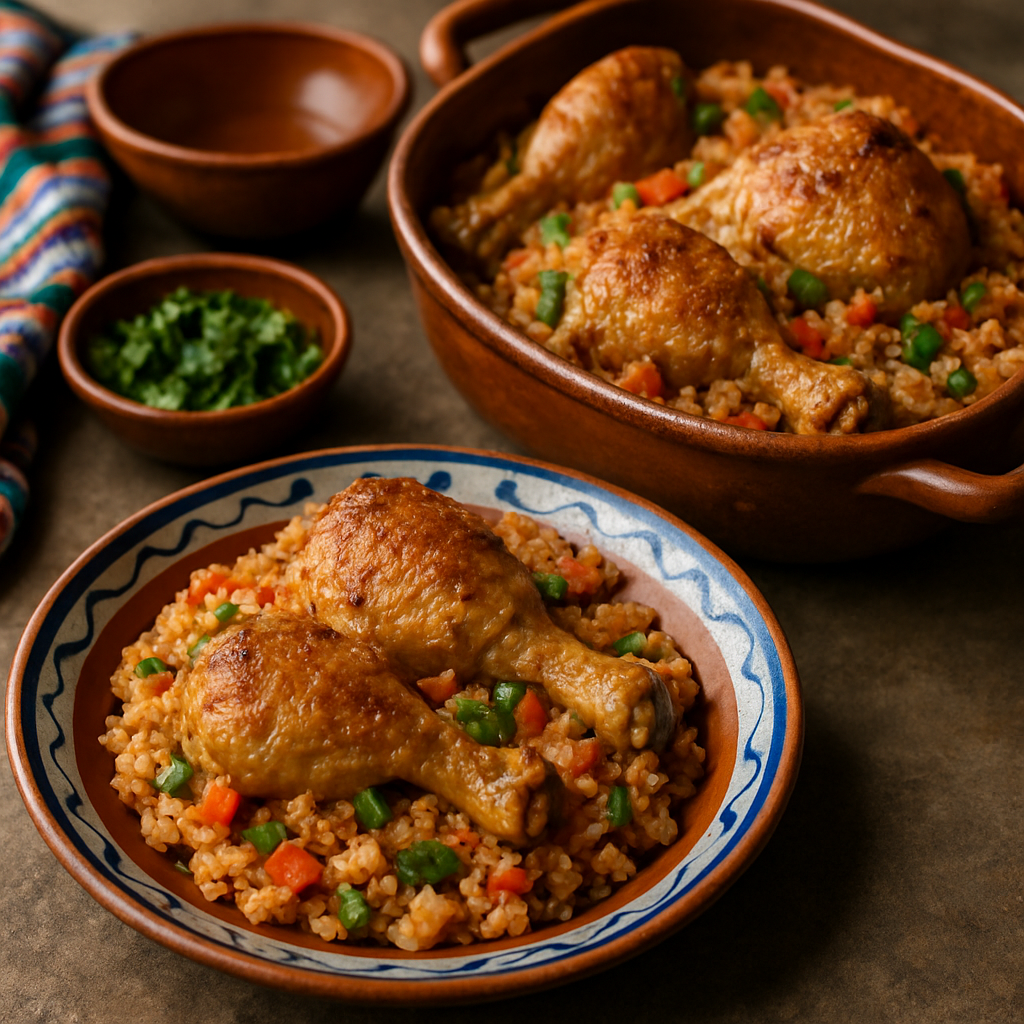
Arroz con Pollo de mi Cocina
When the family comes through the door hungry and the evening is already running away from you, this is what I make. Chicken and rice together in one pot, with tomato, green chile, and cumin toasted right in the pan — not from a jar, never from a jar. This is the kind of cooking that settles the house, that makes everyone sit down without being asked. #oaxacan #mexican #chicken #rice #one-pot #comida de familia
60
min total
(Prep:
15
| Cook: 45)
6
servings
2

Chicken, thigh, boneless, skinless, raw
1.2e3 gram
Oil, olive, salad or cooking
3.0 tablespoon
Onions, yellow, raw
150.0 gram
Garlic, raw
4.0 clove
Peppers, hot chili, green, raw
2.0 pepper
Tomato, roma
400.0 gram
Rice, white, long-grain, regular, raw, enriched
2.0 cup
Water, NFS
4.0 1 cup
Salt, table
1.0 tsp
Spices, oregano, dried
1.0 g
Spices, cumin seed
1.5 g
Nutrition Facts
Energy
3697.9 kilocalorie
Protein
256.8 gram
Myristoleic acid (C14:1)
0.0 gram
Pentadecenoic acid (C15:1)
0.0 gram
Palmitoleic acid (C16:1, Omega-7)
0.5 gram
Heptadecenoic acid (C17:1)
0.1 gram
Gondoic acid (C20:1, Omega-9)
0.1 gram
Erucic acid (C22:1, Omega-9)
0.0 gram
Nervonic acid (C24:1, Omega-9)
0.0 gram
Oleic acid (C18:1, Omega-9)
30.1 gram
Alpha-Linolenic acid (ALA) (C18:3, Omega-3)
0.0 gram
Docosahexaenoic acid (DHA) (C22:6, Omega-3)
0.0 gram
Eicosapentaenoic acid (EPA) (C20:5, Omega-3)
0.0 gram
Pufa 2:5 N-3 (epa)
0.0 gram
Linoleic acid (C18:2, Omega-6)
4.7 gram
Gamma-Linolenic acid (GLA) (C18:3, Omega-6)
0.0 gram
Stearidonic acid (SDA) (C18:4, Omega-3)
0.0 gram
Eicosadienoic acid (C20:2, Omega-6)
0.0 gram
Dihomo-gamma-linolenic acid (DGLA) (C20:3, Omega-6)
0.0 gram
Arachidonic acid (ARA) (C20:4, Omega-6)
0.0 gram
Docosapentaenoic acid (DPA) (C22:5, Omega-3)
0.0 gram
Palmitic acid (C16:0)
5.2 gram
Capric acid (C10:0)
0.0 gram
Lauric acid (C12:0)
0.0 gram
Tridecylic acid (C13:0)
0.0 gram
Myristic acid (C14:0)
0.0 gram
Pentadecylic acid (C15:0)
0.0 gram
Margaric acid (C17:0)
0.0 gram
Arachidic acid (C20:0)
0.2 gram
Behenic acid (C22:0)
0.1 gram
Lignoceric acid (C24:0)
0.0 gram
Butyric acid (C4:0)
0.0 gram
Caproic acid (C6:0)
0.0 gram
Caprylic acid (C8:0)
0.0 gram
Stearic acid (C18:0)
0.9 gram
Trans Fat
0.3 gram
Dietary Fiber
18.0 gram
Lactose
0.0 gram
Maltose
0.0 gram
Sucrose
2.7 gram
Fructose
3.0 gram
Galactose
0.0 gram
Glucose
3.6 gram
Carotene, Alpha
24.4 microgram
Carotene, Beta
1742.6 microgram
Choline
35.5 milligram
Folate (Vitamin B9)
2427.4 microgram
Retinol
0.0 microgram
Vitamin A
1271.7 microgram
Vitamin B-12
0.0 microgram
Vitamin B-12, Added
0.0 microgram
Vitamin B-6
1.3 milligram
Vitamin B1 (Thiamin)
2.5 milligram
Vitamin B2 (Riboflavin)
0.3 milligram
Vitamin B3 (Niacin)
18.8 milligram
Vitamin B5 (Pantothenic Acid)
3.9 milligram
Vitamin B7 (Biotin)
1.9 microgram
Vitamin C
305.3 milligram
Vitamin D
0.0 International Unit
Vitamin E
7.2 milligram
Vitamin K
44.2 microgram
Vitamins And Other Components
0.0 gram
Calcium, Ca
376.4 milligram
Copper, Cu
1.8 milligram
Iron, Fe
28.0 milligram
Magnesium, Mg
458.9 milligram
Manganese, Mn
5.2 milligram
Phosphorus, P
2765.9 milligram
Potassium, K
5158.4 milligram
Selenium, Se
58.2 microgram
Sodium, Na
3139.1 milligram
Zinc, Zn
21.5 milligram
ALA (Alpha-Linolenic Acid, Omega-3)
3.1 gram
Alcohol, Ethyl
0.0 gram
Amino Acids
0.0 gram
Arginine
2.4 gram
Ash
22.8 gram
Aspartic Acid
2.8 gram
Betaine
0.1 milligram
Caffeine
0.0 milligram
Carotene, Gamma
8.5 microgram
Cholesterol
1100.4 milligram
Cis-lutein/zeaxanthin
0.0 microgram
Cryptoxanthin, Alpha
38.5 microgram
Cryptoxanthin, Beta
121.5 microgram
Cystine
0.6 gram
Fluoride, F
0.1 microgram
Folic Acid
825.1 microgram
Glutamic Acid
5.5 gram
Glycine
1.3 gram
Histidine
0.7 gram
Hydroxyproline
0.0 gram
Iodine, I
0.0 microgram
Isoleucine
1.2 gram
Leucine
2.3 gram
Lipids
0.0 gram
Lutein
224.0 microgram
Lutein + Zeaxanthin
911.5 microgram
Lycopene
11440.0 microgram
Lysine
1.1 gram
Methionine
0.7 gram
Nitrogen
36.2 gram
Oleic Acid (Omega-9)
0.0 gram
Phytosterols
93.7 milligram
Proline
1.3 gram
Proximates
0.0 gram
Serine
1.5 gram
Theobromine
0.0 milligram
Threonine
1.0 gram
Tocopherol, Beta
0.0 milligram
Tocopherol, Delta
0.0 milligram
Tocopherol, Gamma
0.6 milligram
Tryptophan
0.3 gram
Tyrosine
0.9 gram
Valine
1.7 gram
Water
2477.0 gram
Zeaxanthin
0.0 microgram
0
Pour your oil into a heavy pot — clay if you have it, cast iron if you don't — and let it warm over medium-high heat until it shimmers and moves like water. Salt your chicken thighs on both sides, don't be shy. Lay them skin-side down and do not touch them. Let them sit for 5 to 7 minutes, listening to that steady sizzle. When the skin has turned deep golden and pulls away from the pot on its own, it is ready to turn — the chicken will tell you, not the clock. Give the other side 4 to 5 minutes, then lift the pieces out and set them aside on a plate.
1
Into that same pot, with all those good brown bits still waiting at the bottom, go your onion. Stir it every now and then for 3 to 4 minutes until it softens and smells sweet, and the edges go a little translucent. Now the garlic and the green chile together — another 1 to 2 minutes, just until the garlic turns soft and fragrant. The moment it starts to smell sharp and dark, you have gone too far. Watch it.
2
Add your cumin seed directly into the pot and stir it constantly for about 30 seconds. You will smell when it is ready — a warm, smoky, earthy perfume rising up from the pot. That is the real flavor of cumin, and toasting wakes it up. Now put in your tomato, fresh if the market had good ones, otherwise the can drained well. Break it down with the back of your spoon and let it cook 3 to 4 minutes until it darkens, thickens, and smells concentrated and deep. This is the soul of the pot.
3
Pour in the rice and stir it into the tomato and fat for 1 to 2 minutes. You want each grain coated, a little toasted, and you will hear a soft clicking sound against the pot as the rice dries slightly — that is the sound of rice that will cook up separate and alive, not soggy. Add your water, crumble in the oregano between your palms so the oils open up, and salt to taste — start with a teaspoon and decide later. One stir to bring it all together.
4
Nestle your browned chicken thighs back into the pot, pressing them down gently so they sit among the rice and the liquid comes up around them. Turn the heat to high and bring everything to a rolling boil — you will see steam pushing up and hear the rice beginning to bubble and pop. From this moment, you do not stir. Stirring now breaks the grains and makes everything sticky and sad. Trust the pot.
5
Put the lid on — a tight lid, no gaps — and turn the heat down to low. Now you walk away for 25 to 30 minutes and you let the pot do its work. The rice is done when all the water is gone and each grain is tender but still standing on its own. Press your ear near the pot: silence means it is finished. If you still hear a faint bubbling, give it a few more minutes. If the rice is not yet tender but the water is gone, add just a small splash more, cover again, and wait. Do not lift the lid to check — every time you lift that lid, you are letting the steam escape and stealing time from your rice.
6
Take the pot off the heat and leave it covered for 5 full minutes. This is not optional, this is part of the cooking. The rice finishes absorbing, the flavors settle into each other, the chicken rests. When you lift the lid after those 5 minutes, the steam will rise up carrying tomato and cumin and oregano and chicken all together — that smell is the whole reason you cooked today. Breathe it in.
7
Take a fork and fluff the rice with a light hand, lifting rather than stirring, so the grains stay whole. Taste it and add salt if it needs it. Serve hot in deep bowls — rice, chicken, and plenty of the broth soaked into everything. If you have fresh green chile left, scatter a little on top for those who want the heat. This is not a dish you eat in a hurry. Sit down, eat it warm, and if there is any left tomorrow, it reheats gently and the flavors will be even deeper than tonight.
Loading comments…