Discover Recipes
Explore recipes from our community
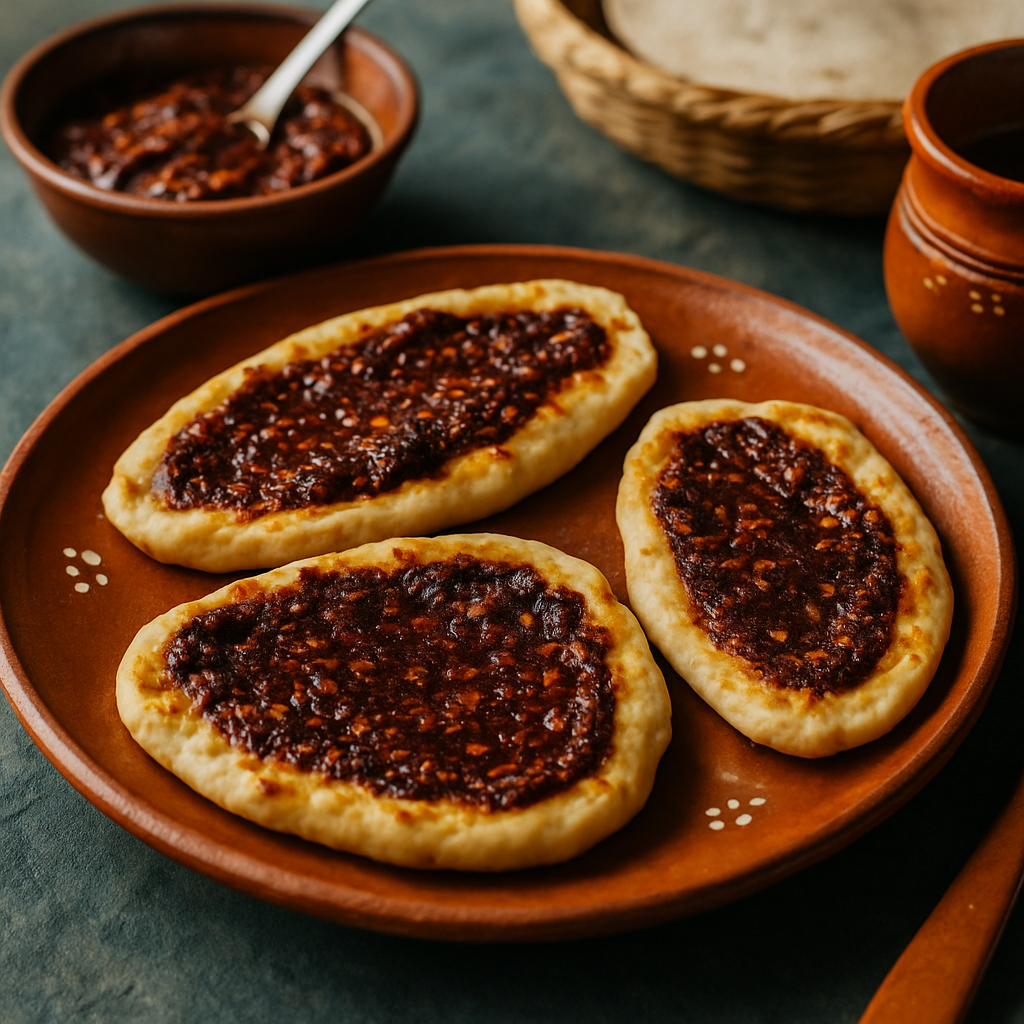
Memelas de Comal con Salsa de Chile Seco
These memelas are what I make when the afternoon gets long and the family starts to hover near the kitchen. Thick masa, toasted in lard on a hot comal, pinched at the edges to hold a salsa I grind from toasted chiles — nothing from a jar, nothing from a packet. This is market-day food, honest and fast, and it tastes exactly like Oaxaca on a warm afternoon should taste. #oaxacan #masa #mexican #snack #traditional #vegetarian
25
min total
(Prep:
10
| Cook: 15)
4
servings

Corn flour, yellow, masa, enriched
2.0 cup
Lard
3.0 1 tablespoon
Salt, table
0.5 tsp
Epazote, raw
2.0 tbsp
Peppers, hot chile, sun-dried
1.5 gram
Tomato, roma
220.0 gram
Garlic, raw
2.0 clove
Spices, oregano, dried
1.0 gram
Black beans, NFS
0.5 1 cup
Onions, white, raw
0.25 g
Spices, cumin seed
0.5 g
Nutrition Facts
Energy
1389.9 kilocalorie
Protein
29.4 gram
Myristoleic acid (C14:1)
0.0 gram
Pentadecenoic acid (C15:1)
0.0 gram
Palmitoleic acid (C16:1, Omega-7)
1.0 gram
Heptadecenoic acid (C17:1)
0.0 gram
Gondoic acid (C20:1, Omega-9)
0.4 gram
Erucic acid (C22:1, Omega-9)
0.0 gram
Nervonic acid (C24:1, Omega-9)
0.0 gram
Oleic acid (C18:1, Omega-9)
19.8 gram
Alpha-Linolenic acid (ALA) (C18:3, Omega-3)
0.0 gram
Docosahexaenoic acid (DHA) (C22:6, Omega-3)
0.0 gram
Eicosapentaenoic acid (EPA) (C20:5, Omega-3)
0.0 gram
Pufa 2:5 N-3 (epa)
0.0 gram
Linoleic acid (C18:2, Omega-6)
9.7 gram
Gamma-Linolenic acid (GLA) (C18:3, Omega-6)
0.0 gram
Stearidonic acid (SDA) (C18:4, Omega-3)
0.0 gram
Eicosadienoic acid (C20:2, Omega-6)
0.0 gram
Dihomo-gamma-linolenic acid (DGLA) (C20:3, Omega-6)
0.0 gram
Arachidonic acid (ARA) (C20:4, Omega-6)
0.0 gram
Docosapentaenoic acid (DPA) (C22:5, Omega-3)
0.0 gram
Palmitic acid (C16:0)
10.3 gram
Capric acid (C10:0)
0.0 gram
Lauric acid (C12:0)
0.1 gram
Tridecylic acid (C13:0)
0.0 gram
Myristic acid (C14:0)
0.5 gram
Pentadecylic acid (C15:0)
0.0 gram
Margaric acid (C17:0)
0.0 gram
Arachidic acid (C20:0)
0.0 gram
Behenic acid (C22:0)
0.0 gram
Lignoceric acid (C24:0)
0.0 gram
Butyric acid (C4:0)
0.0 gram
Caproic acid (C6:0)
0.0 gram
Caprylic acid (C8:0)
0.0 gram
Stearic acid (C18:0)
5.2 gram
Trans Fat
0.0 gram
Dietary Fiber
25.6 gram
Starch
150.5 gram
Lactose
0.0 gram
Maltose
0.0 gram
Sucrose
0.1 gram
Fructose
0.5 gram
Galactose
0.0 gram
Glucose
0.6 gram
Carotene, Alpha
160.7 microgram
Carotene, Beta
1070.0 microgram
Choline
49.2 milligram
Folate (Vitamin B9)
1428.0 microgram
Retinol
0.0 microgram
Vitamin A
1016.1 microgram
Vitamin B-12
0.0 microgram
Vitamin B-12, Added
0.0 microgram
Vitamin B-6
1.4 milligram
Vitamin B1 (Thiamin)
3.7 milligram
Vitamin B2 (Riboflavin)
1.9 milligram
Vitamin B3 (Niacin)
24.5 milligram
Vitamin B5 (Pantothenic Acid)
0.5 milligram
Vitamin B7 (Biotin)
1.0 microgram
Vitamin C
41.7 milligram
Vitamin D
0.9 microgram
Vitamin E
2.4 milligram
Vitamin K
16.9 microgram
Vitamins And Other Components
0.0 gram
Calcium, Ca
406.5 milligram
Copper, Cu
0.8 milligram
Iron, Fe
22.7 milligram
Magnesium, Mg
303.3 milligram
Manganese, Mn
1.3 milligram
Phosphorus, P
714.8 milligram
Potassium, K
1451.0 milligram
Selenium, Se
26.1 microgram
Sodium, Na
1381.6 milligram
Zinc, Zn
5.5 milligram
ALA (Alpha-Linolenic Acid, Omega-3)
2.4 gram
Alcohol, Ethyl
0.0 gram
Amino Acids
0.0 gram
Arginine
0.9 gram
Ash
7.4 gram
Aspartic Acid
1.3 gram
Betaine
0.1 milligram
Caffeine
0.0 milligram
Carotene, Gamma
4.7 microgram
Cholesterol
34.2 milligram
Cis-lutein/zeaxanthin
0.0 microgram
Cryptoxanthin, Alpha
21.2 microgram
Cryptoxanthin, Beta
58.6 microgram
Cystine
0.4 gram
Fluoride, F
0.1 microgram
Folic Acid
303.2 microgram
Glutamic Acid
3.7 gram
Glycine
0.7 gram
Histidine
0.6 gram
Hydroxyproline
0.0 gram
Isoleucine
0.7 gram
Leucine
2.4 gram
Lipids
0.0 gram
Lutein
123.2 microgram
Lutein + Zeaxanthin
243.9 microgram
Lycopene
6292.0 microgram
Lysine
0.5 gram
Methionine
0.4 gram
Nitrogen
0.3 gram
Oleic Acid (Omega-9)
0.0 gram
Phytosterols
2.7 milligram
Proline
1.6 gram
Proximates
0.0 gram
Serine
1.0 gram
Theobromine
0.0 milligram
Threonine
0.6 gram
Tocopherol, Beta
0.0 milligram
Tocopherol, Delta
0.0 milligram
Tocopherol, Gamma
0.2 milligram
Tryptophan
0.1 gram
Tyrosine
0.5 gram
Valine
0.9 gram
Water
311.8 gram
Zeaxanthin
0.0 microgram
0
We begin with the salsa, because the salsa must rest while the masa works. Lay your sun-dried chiles directly on a dry comal over medium heat and toast them, turning them every few seconds for about a minute. You will know they are ready when the kitchen fills with their fragrance — deep, a little smoky, alive. The color will darken just slightly. Pull them off the moment before you think they are done. A burned chile is a bitter chile, and there is no fixing that.
1
Let the chiles cool until your hands can hold them, then tear them open, shake out the seeds — leave some if your family likes the fire — and drop the pieces into your molcajete. Toast the cumin seed in the same dry pan, thirty seconds only, until it jumps in color and smells like something. Add it to the molcajete. Grind everything together until you have a rough, dark paste with some texture still in it. The stone does this better than any machine. Use the machine only if you must.
2
Chop the tomatoes and garlic roughly — this is not the time for fine knife work. Dice a quarter of the onion small. Bring everything together in a bowl with your chile paste, the dried oregano, and a good pinch of salt. Mix it with your hands or a wooden spoon until it comes together into something that still has body, still has resistance. Taste it now. It should wake up your mouth. If it needs salt, give it salt. This salsa should not be smooth — memelas need something to hold onto.
3
In a bowl, combine your masa with salt and work in warm water a little at a time — a few tablespoons to start. Mix with your hands for a couple of minutes until the masa is soft and pliable and holds itself together. Not dry, because dry masa will crack on the comal. Not wet, because wet masa will cling to your palms and break your heart. You are looking for something that feels like cool, forgiving clay — soft but with a little push back when you press it.
4
Wet your hands and pull off a piece of masa about the size of a golf ball. Press it between your palms into a thick disc — three inches across, no more than a quarter inch thick. Thicker than a tortilla, thinner than a cake. Set each disc on a piece of plastic as you go so they don't dry out or stick. This batch makes four memelas. Take your time with the shaping. The comal will wait for you.
5
Get your comal or heavy griddle very hot over medium-high heat, then add the lard and let it coat the surface. Lay a memela down — it should sizzle the moment it touches the fat. Cook the first side for about two minutes. You are waiting for the bottom to firm up and take on a light golden color. Listen to it: a hot, loud sizzle at first, and then the sound settles into something quieter. That quieter crackle is the masa telling you it has set. Do not rush this.
6
Flip the memela gently and cook the second side for about a minute, just until it firms. Now, while it is still on the comal, use your fingertips to press the edges up all around — a small wall, a quarter inch high, like a little cradle for the filling. Work quickly but without fear. The masa has set enough to hold the shape. This pinching is the gesture that makes a memela a memela. Every abuela's hands know how to do it.
7
With the memela still on the comal and its walls standing, spoon two tablespoons of salsa into the center, then lay two tablespoons of black beans on top. Let it all sit together on the heat for thirty to forty-five seconds — just long enough for the filling to warm through and the salsa to begin to meld into the masa. Lift it to a plate and start the next one. Each memela is best eaten as it comes off the comal, one by one, still warm.
8
Tear a fresh sprig of epazote over each memela before you bring it to the table. Epazote is the perfume of this food — without it something is missing, though only you will know what. Serve immediately. The masa wants to be eaten warm, the salsa wants to be bright, and the family has been waiting long enough. Nothing else is needed here. This is the food that is simple and complete at the same time, and that is the hardest thing to make.
Loading comments…