Discover Recipes
Explore recipes from our community
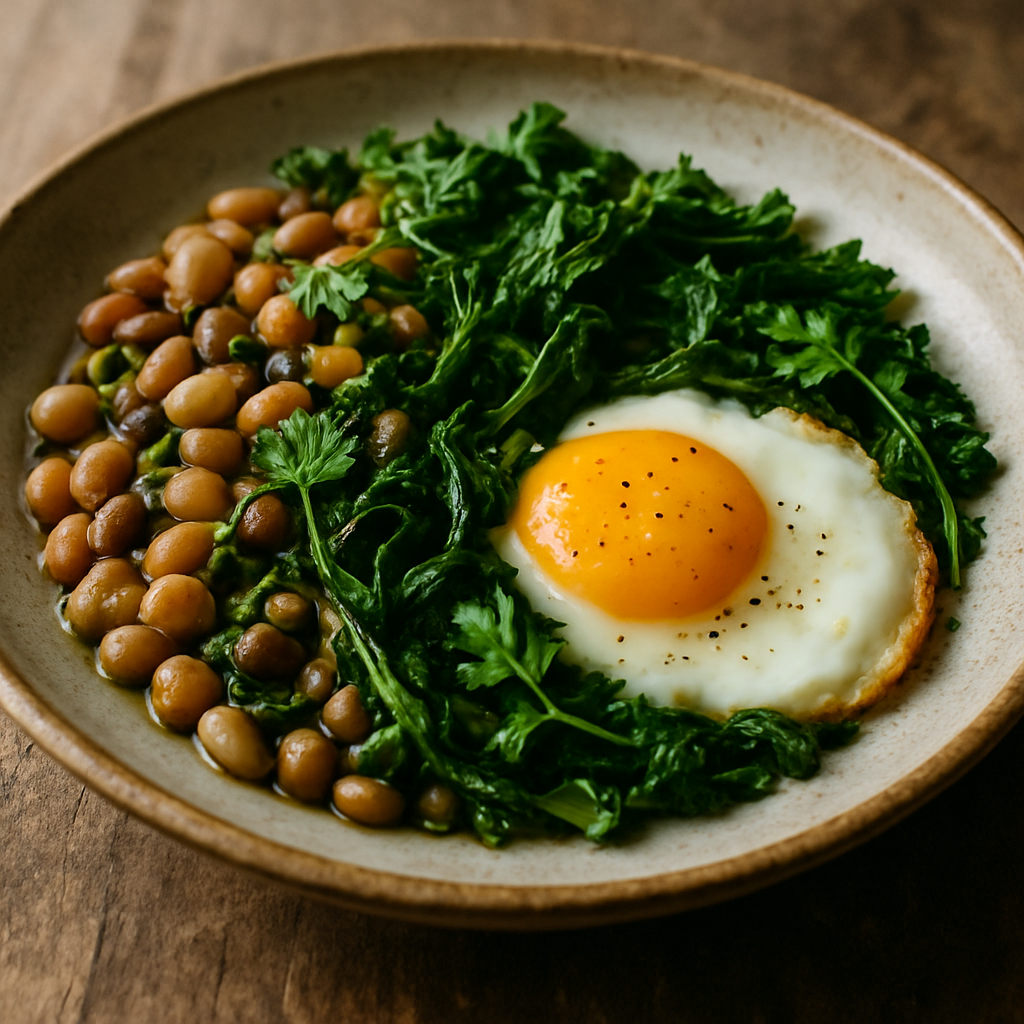
Κουκιά με Χρυσάνθεμο και Αυγό Μάτι — Fava and Cowpeas with Garland Greens and a Fried Egg
This is the breakfast I come back to again and again, especially after an early morning at a nutrition summit when I need something that truly sustains me through a long day of talks. My mother made a version of this in our Athens kitchen — legumes, whatever bitter greens she had, a good egg from the market — and I have refined it over the years with what I now know about protein balance and the Mediterranean dietary pattern. Simple, honest, and deeply nourishing. #Mediterranean #Greek breakfast #legumes #egg #bitter greens #nutritious
25
min total
(Prep:
10
| Cook: 15)
2
servings
2

Fava beans, cooked
80.0 gram
Cowpeas , immature seeds, cooked, boiled, drained, with salt
80.0 gram
Chrysanthemum, garland, cooked, boiled, drained, with salt
60.0 gram
Olive oil
30.0 gram
Garlic, raw
4.0 gram
Lemon juice, raw
15.0 gram
Eggs, Grade A, Large, egg whole
100.0 gram
Salt, table
2.0 gram
Sauce, ready-to-serve, pepper or hot
0.5 gram
Nutrition Facts
Energy
643.3 kilocalorie
Protein
21.9 gram
Myristoleic acid (C14:1)
0.0 gram
Pentadecenoic acid (C15:1)
0.0 gram
Palmitoleic acid (C16:1, Omega-7)
0.3 gram
Heptadecenoic acid (C17:1)
0.0 gram
Gondoic acid (C20:1, Omega-9)
0.1 gram
Erucic acid (C22:1, Omega-9)
0.0 gram
Nervonic acid (C24:1, Omega-9)
0.0 gram
Oleic acid (C18:1, Omega-9)
22.3 gram
Alpha-Linolenic acid (ALA) (C18:3, Omega-3)
0.0 gram
Docosahexaenoic acid (DHA) (C22:6, Omega-3)
0.0 gram
Eicosapentaenoic acid (EPA) (C20:5, Omega-3)
0.0 gram
Pufa 2:5 N-3 (epa)
0.0 gram
Linoleic acid (C18:2, Omega-6)
1.5 gram
Gamma-Linolenic acid (GLA) (C18:3, Omega-6)
0.0 gram
Stearidonic acid (SDA) (C18:4, Omega-3)
0.0 gram
Eicosadienoic acid (C20:2, Omega-6)
0.0 gram
Eicosatrienoic acid (ETE) (C20:3, Omega-3)
0.0 gram
Dihomo-gamma-linolenic acid (DGLA) (C20:3, Omega-6)
0.0 gram
Arachidonic acid (ARA) (C20:4, Omega-6)
0.0 gram
Adrenic acid (DTA) (C22:4, Omega-6)
0.0 gram
Docosapentaenoic acid (DPA) (C22:5, Omega-3)
0.0 gram
Palmitic acid (C16:0)
6.6 gram
Capric acid (C10:0)
0.0 gram
Lauric acid (C12:0)
0.0 gram
Myristic acid (C14:0)
0.0 gram
Pentadecylic acid (C15:0)
0.0 gram
Margaric acid (C17:0)
0.0 gram
Arachidic acid (C20:0)
0.0 gram
Behenic acid (C22:0)
0.0 gram
Lignoceric acid (C24:0)
0.0 gram
Butyric acid (C4:0)
0.0 gram
Caproic acid (C6:0)
0.0 gram
Caprylic acid (C8:0)
0.0 gram
Stearic acid (C18:0)
1.8 gram
Palmitelaidic acid (C16:1)
0.0 gram
Linolelaidic acid (C18:2)
0.0 gram
Erucic acid (C22:1, Omega-9)
0.0 gram
Dietary Fiber
9.5 gram
Starch
0.0 gram
Lactose
0.0 gram
Maltose
0.0 gram
Sucrose
0.1 gram
Fructose
0.2 gram
Galactose
0.0 gram
Glucose
0.3 gram
Carotene, Alpha
0.0 microgram
Carotene, Beta
1311.2 microgram
Choline
728.7 milligram
Folate (Vitamin B9)
696.0 microgram
Retinol
179.0 microgram
Vitamin A
2467.1 microgram
Vitamin B-12
1.0 microgram
Vitamin B-12, Added
0.0 microgram
Vitamin B-6
0.3 milligram
Vitamin B1 (Thiamin)
0.3 milligram
Vitamin B2 (Riboflavin)
0.7 milligram
Vitamin B3 (Niacin)
2.1 milligram
Vitamin B5 (Pantothenic Acid)
0.2 milligram
Vitamin C
23.8 milligram
Vitamin D
103.3 microgram
Vitamin E
9.0 milligram
Vitamin K
101.0 microgram
Calcium, Ca
228.0 milligram
Copper, Cu
0.4 milligram
Iron, Fe
6.2 milligram
Magnesium, Mg
97.7 milligram
Manganese, Mn
0.7 milligram
Phosphorus, P
350.8 milligram
Potassium, K
1039.7 milligram
Selenium, Se
35.8 microgram
Sodium, Na
1461.0 milligram
Zinc, Zn
3.0 milligram
25-hydroxycholecalciferol
0.6 microgram
ALA (Alpha-Linolenic Acid, Omega-3)
1.5 gram
Alcohol, Ethyl
0.0 gram
Arginine
1.0 gram
Ash
4.8 gram
Aspartic Acid
1.3 gram
Betaine
0.3 milligram
Caffeine
0.0 milligram
Cholesterol
411.0 milligram
Cis-beta-carotene
0.0 microgram
Cis-lutein/zeaxanthin
57.0 microgram
Cis-lycopene
0.0 microgram
Cryptoxanthin, Alpha
13.0 microgram
Cryptoxanthin, Beta
13.6 microgram
Cysteine
0.4 gram
Cystine
0.0 gram
Fluoride, F
0.0 microgram
Folic Acid
0.0 microgram
Glutamic Acid
1.7 gram
Glycine
0.4 gram
Histidine
0.4 gram
Hydroxyproline
0.0 gram
Iodine, I
49.1 microgram
Isoleucine
0.8 gram
Leucine
1.2 gram
Lutein
230.0 microgram
Lutein + Zeaxanthin
2085.5 microgram
Lycopene
0.0 microgram
Lysine
1.0 gram
Methionine
0.5 gram
Nitrogen
2.0 gram
Oleic Acid (Omega-9)
0.0 gram
Phytosterols
0.0 milligram
Proline
0.6 gram
Serine
0.9 gram
Theobromine
0.0 milligram
Threonine
0.7 gram
Trans-beta-carotene
0.0 microgram
Trans-lycopene
0.0 microgram
Tryptophan
0.2 gram
Tyrosine
0.6 gram
Valine
0.9 gram
Water
261.5 gram
Zeaxanthin
229.0 microgram
0
Warm two tablespoons of olive oil in a medium saucepan over medium heat for about a minute, until it just begins to shimmer and you catch that first fragrant breath rising from the pan. Add your minced garlic and stir constantly for no more than 30 seconds — you want it golden and soft, not browned. The moment it turns bitter, the whole base is lost, so stay close.
1
Add the cooked fava beans and cowpeas directly into the garlic oil and stir gently for 2 to 3 minutes, just enough to warm them through and let them drink in the flavour. You are not cooking them further — they should hold their shape completely. When the kitchen smells unmistakably Mediterranean, you are ready to move on.
2
Tumble in the garland chrysanthemum greens and keep stirring for 2 to 3 minutes as they collapse down — they will reduce to about a third of their volume and deepen to a rich, dark green. If the pile feels unmanageable at first, add them in two batches and let the first wave wilt before adding the rest. Season well with sea salt and freshly ground black pepper, and taste as you go.
3
Spoon the warm bean and greens mixture into two shallow bowls, pressing a small well into the centre of each. Squeeze about half a lemon over each serving — do not skip this step. The acid lifts everything, brightens the legumes, and from a nutritional standpoint it also helps with iron absorption from the greens. A small detail that makes a real difference.
4
In a small nonstick pan, heat one tablespoon of olive oil over medium heat and crack in your eggs. I cook mine low and slow, about 3 to 4 minutes, until the whites are just set and the yolk still jiggles gently when you nudge the pan. The edges will curl very slightly — that is your cue. High heat makes the whites rubbery before the yolk even has a chance.
5
Slide one egg carefully into the well of each bowl and let it sit for a moment so the yolk begins to run into the beans. Then give it a gentle stir — the yolk becomes your sauce, binding the legumes and greens into something far richer than its parts. Finish with a thread of your best extra virgin olive oil and a small pinch of flaky sea salt. This is the kind of breakfast Athens deserves.
Loading comments…