Discover Recipes
Explore recipes from our community
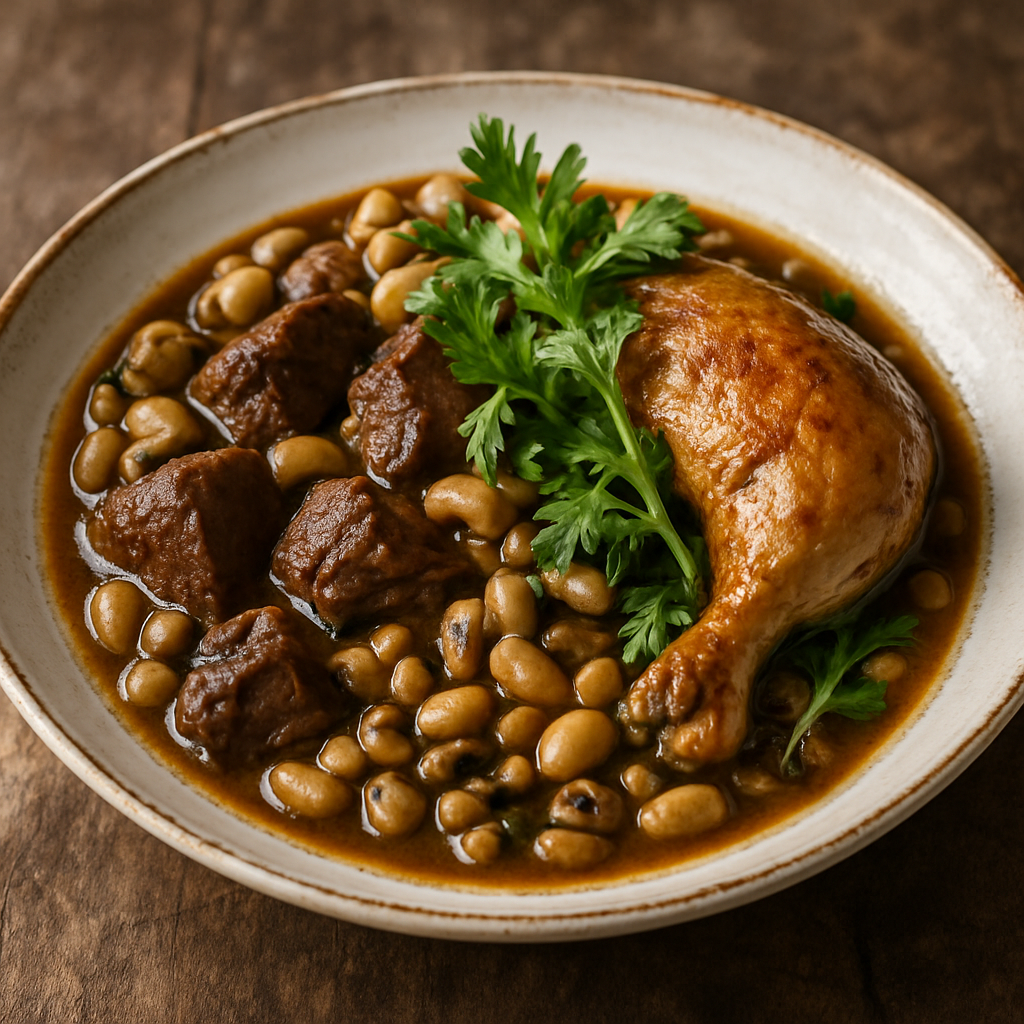
Στοφάδο με Όσπρια και Κοτόπουλο — Braised Chicken, Beef and Legume Stew
This is a pot I come back to whenever I want something that feeds both the body and the soul — a slow braise rooted in Greek tradition but built with everything I know about nutrition. Dark chicken meat, beef chuck, cowpeas, and fava beans all find their place together here, finished with chrysanthemum greens that bring a gentle bitter lift at the end. I make this on Sunday afternoons in autumn and winter, when Athens cools down enough that the aromas of slow-cooked onion and thyme feel like exactly what the kitchen needs. #mediterranean #greek #stew #legumes #chicken #one-pot
115
min total
(Prep:
25
| Cook: 90)
6
servings
2

Cowpeas, common , mature seeds, raw
150.0 gram
Beef, New Zealand, imported, chuck eye roll, separable lean and fat, raw
400.0 gram
Chicken, drumstick, meat and skin, raw
400.0 gram
Broadbeans , mature seeds, cooked, boiled, without salt
200.0 gram
Beans, french, mature seeds, cooked, boiled, without salt
150.0 gram
Olive oil
80.0 gram
Onions, raw
250.0 gram
Garlic, raw
30.0 gram
Tomato, roma
400.0 gram
Thyme, fresh
5.0 gram
Lemon juice, raw
30.0 gram
Water, NFS
500.0 gram
Salt, table
5.0 gram
Chrysanthemum, garland, cooked, boiled, drained, with salt
150.0 gram
Nutrition Facts
Energy
3143.8 kilocalorie
Protein
222.5 gram
Myristoleic acid (C14:1)
0.2 gram
Pentadecenoic acid (C15:1)
0.0 gram
Palmitoleic acid (C16:1, Omega-7)
2.1 gram
Heptadecenoic acid (C17:1)
0.0 gram
Gondoic acid (C20:1, Omega-9)
0.3 gram
Erucic acid (C22:1, Omega-9)
0.0 gram
Nervonic acid (C24:1, Omega-9)
0.0 gram
Oleic acid (C18:1, Omega-9)
68.6 gram
Alpha-Linolenic acid (ALA) (C18:3, Omega-3)
0.4 gram
Docosahexaenoic acid (DHA) (C22:6, Omega-3)
0.0 gram
Eicosapentaenoic acid (EPA) (C20:5, Omega-3)
0.0 gram
Pufa 2:5 N-3 (epa)
0.1 gram
Linoleic acid (C18:2, Omega-6)
0.5 gram
Gamma-Linolenic acid (GLA) (C18:3, Omega-6)
0.0 gram
Stearidonic acid (SDA) (C18:4, Omega-3)
0.0 gram
Eicosadienoic acid (C20:2, Omega-6)
0.0 gram
Eicosatrienoic acid (ETE) (C20:3, Omega-3)
0.0 gram
Dihomo-gamma-linolenic acid (DGLA) (C20:3, Omega-6)
0.0 gram
Arachidonic acid (ARA) (C20:4, Omega-6)
0.1 gram
Adrenic acid (DTA) (C22:4, Omega-6)
0.0 gram
Docosapentaenoic acid (DPA) (C22:5, Omega-3)
0.1 gram
Pufa 2:4 N-6
0.1 gram
Palmitic acid (C16:0)
19.3 gram
Capric acid (C10:0)
0.0 gram
Lauric acid (C12:0)
0.0 gram
Myristic acid (C14:0)
1.0 gram
Pentadecylic acid (C15:0)
0.0 gram
Margaric acid (C17:0)
0.6 gram
Arachidic acid (C20:0)
0.1 gram
Behenic acid (C22:0)
0.0 gram
Lignoceric acid (C24:0)
0.0 gram
Butyric acid (C4:0)
0.0 gram
Caproic acid (C6:0)
0.0 gram
Caprylic acid (C8:0)
0.0 gram
Stearic acid (C18:0)
9.4 gram
Palmitelaidic acid (C16:1)
0.1 gram
Linolelaidic acid (C18:2)
0.0 gram
Erucic acid (C22:1, Omega-9)
0.0 gram
Dietary Fiber
53.8 gram
Starch
0.0 gram
Lactose
0.0 gram
Maltose
0.0 gram
Sucrose
2.6 gram
Fructose
3.6 gram
Galactose
0.0 gram
Glucose
5.2 gram
Carotene, Alpha
3.5 microgram
Carotene, Beta
3623.8 microgram
Choline
246.4 milligram
Folate (Vitamin B9)
4244.9 microgram
Retinol
32.0 microgram
Vitamin A
4655.0 International Unit
Vitamin B-12
8.3 microgram
Vitamin B-12, Added
0.0 microgram
Vitamin B-6
2.7 milligram
Vitamin B1 (Thiamin)
2.3 milligram
Vitamin B2 (Riboflavin)
1.4 milligram
Vitamin B3 (Niacin)
19.9 milligram
Vitamin B5 (Pantothenic Acid)
4.5 milligram
Vitamin B7 (Biotin)
1.9 microgram
Vitamin C
159.2 milligram
Vitamin D
25.6 microgram
Vitamin E
23.5 milligram
Vitamin K
250.1 microgram
Vitamins And Other Components
0.0 gram
Calcium, Ca
697.8 milligram
Copper, Cu
3.0 milligram
Iron, Fe
35.7 milligram
Magnesium, Mg
708.1 milligram
Manganese, Mn
5.6 milligram
Phosphorus, P
2590.0 milligram
Potassium, K
7085.3 milligram
Selenium, Se
32.1 microgram
Sodium, Na
3024.9 milligram
Zinc, Zn
34.1 milligram
ALA (Alpha-Linolenic Acid, Omega-3)
17.0 gram
Alcohol, Ethyl
0.0 gram
Amino Acids
0.0 gram
Arginine
12.8 gram
Ash
25.9 gram
Aspartic Acid
7.6 gram
Betaine
0.3 milligram
Caffeine
0.0 milligram
Carotene, Gamma
8.5 microgram
Cholesterol
622.4 milligram
Cis-lutein/zeaxanthin
0.0 microgram
Cryptoxanthin, Alpha
38.5 microgram
Cryptoxanthin, Beta
77.6 microgram
Cystine
0.7 gram
Fluoride, F
2.9 microgram
Folic Acid
0.0 microgram
Glutamic Acid
28.5 gram
Glycine
9.1 gram
Histidine
6.2 gram
Isoleucine
7.6 gram
Leucine
13.9 gram
Lipids
0.0 gram
Lutein
224.0 microgram
Lutein + Zeaxanthin
5448.3 microgram
Lycopene
11440.0 microgram
Lysine
13.7 gram
Methionine
4.8 gram
Nitrogen
12.2 gram
Oleic Acid (Omega-9)
1.1 gram
Phytosterols
37.5 milligram
Proline
6.6 gram
Proximates
0.0 gram
Serine
7.4 gram
Theobromine
0.0 milligram
Threonine
6.8 gram
Tocopherol, Beta
0.0 milligram
Tocopherol, Delta
0.0 milligram
Tocopherol, Gamma
0.0 milligram
Tocotrienol, Alpha
0.1 milligram
Tocotrienol, Beta
0.0 milligram
Tocotrienol, Delta
0.0 milligram
Tocotrienol, Gamma
0.0 milligram
Tryptophan
2.0 gram
Tyrosine
6.0 gram
Valine
8.3 gram
Water
2125.3 gram
Zeaxanthin
0.0 microgram
0
Start with the cowpeas. Rinse them under cold running water, rubbing them between your palms for a couple of minutes until the water runs clean. Cover them in a heavy pot with cold water by about three fingers' width, bring to a rolling boil, then immediately drain and rinse well — this first boil draws out the oligosaccharides that make legumes hard on digestion, and my grandmother did this long before anyone called it food science. Return to the pot with fresh cold water and bring to a gentle simmer. Cook for around 45 to 50 minutes until they yield softly when you press one between your fingers — tender but still holding their shape. Drain and set aside.
1
While the cowpeas are doing their thing, cut your beef chuck into roughly 4cm chunks — keep them generous or they'll disappear into the braise. Pat them completely dry with paper towel; moisture is the enemy of a good sear. Heat a generous pour of olive oil in a large heavy pot over medium-high heat until it shimmers, then brown the beef in two batches — never crowd the pan, or you'll steam the meat instead of caramelising it, and you'll lose all that deep flavour the Maillard reaction gives you. About 3 to 4 minutes per side, until the pieces are deeply golden and the smell in your kitchen turns rich and nutty. Set them aside on a plate.
2
In the same pot, add a little more olive oil and tip in your diced onions. Cook over medium heat, stirring every couple of minutes, for about 6 to 7 minutes — you want them soft, just beginning to colour at the edges, smelling sweet rather than sharp. Then add the minced garlic and watch it closely; it only needs about a minute before that unmistakable perfume rises from the pan. Garlic burns fast in hot oil, so add it at the very end of the onion stage and don't walk away.
3
Roughly chop your fresh tomatoes into chunks and add them to the pot along with the browned beef, the drained cowpeas, and about 500ml of cold water. Tuck in a fresh thyme sprig, a good teaspoon of sea salt, and a crack of black pepper, then stir everything together. Bring to a gentle simmer — you want only a few lazy bubbles breaking the surface, not a rolling boil, which will toughen the meat and cloud the broth. Cover and braise quietly for 35 to 40 minutes.
4
About 20 minutes into the braise, nestle the raw chicken drumsticks into the pot among the meat and beans. They'll finish cooking alongside everything else in the remaining 20 minutes. Dark meat is forgiving — it handles slow heat without drying out, which is exactly why drumsticks belong here rather than breast. The chicken is ready when the meat pulls away from the bone easily and a knife slides through the thickest part with almost no resistance; if you have a thermometer, you're looking for 75°C at the centre.
5
In the last 10 minutes, add the drained pre-cooked fava beans and french beans. They just need to warm through — adding cooked legumes late keeps them intact and nutritionally sound, rather than turning them to mush. The stew at this point will look a little soupy, and that is exactly where you want it — the liquid should coat the ingredients generously without drowning them.
6
Just before you bring it to the table, stir through the drained pre-cooked chrysanthemum greens gently and let them warm for about 2 minutes — they'll darken slightly and their subtle, pleasantly bitter note will cut right through the richness of the meat and beans. These greens are delicate, so treat them with care and never add them too early or they'll go grey and lose everything that makes them interesting. Finish with a squeeze of fresh lemon juice, taste the broth, and adjust salt or lemon as needed — the acid should be present but quiet, just a brightness in the background rather than the main voice.
Loading comments…