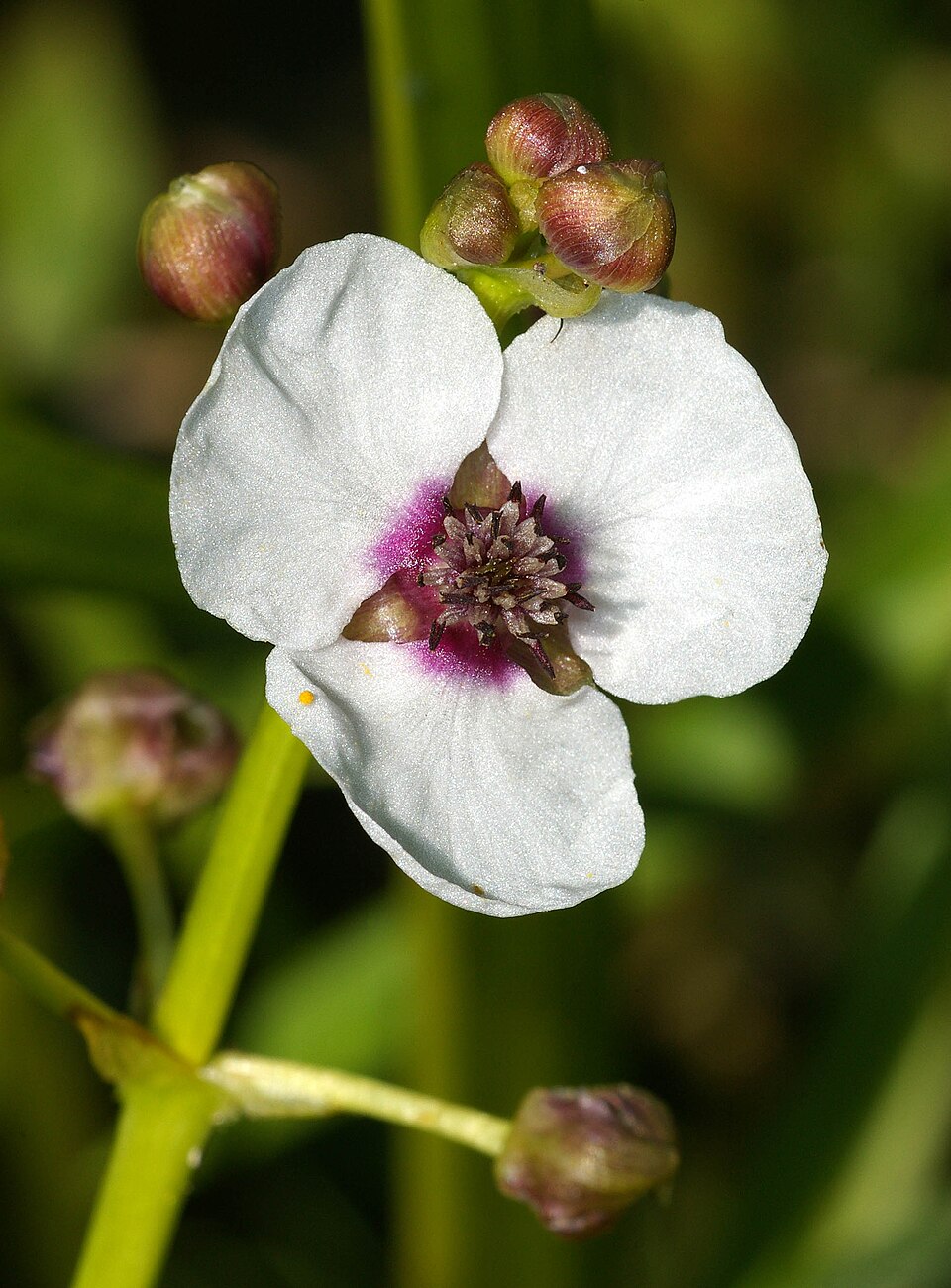
Photo: Christian Fischer CC BY-SA 3.0 via Wikimedia Commons
Nutrition per 100g
Full Nutrition Breakdown per 100g
Per 100 g, Arrowhead also provides 1.2 mg iron, 7.0 mg calcium, 881.0 mg potassium, 49.0 mg magnesium, 0.220 mg zinc and 197.0 mg phosphorus.
Research findings
Each finding is a claim distilled from a published study, with an honest verdict on how strongly the wider literature backs it.
-
The ability of plants to accumulate metals varies greatly and depends on factors such as environmental conditions, growing season, and the type and ecological group of the plant.
CorroboratedCohort study PMID 36400901 -
Using PCR-RFLP, eight cpDNA haplotypes were identified in Sagittaria latifolia.
CorroboratedCohort study PMID 15315682 -
Triclosan (TCS) is 5-chloro-2-[2,4-dichlorophenoxy]phenol.
CorroboratedCohort study PMID 22483729 -
Triclocarban (TCC) is 3,4,4'-trichlorocarbanillide.
CorroboratedCohort study PMID 22483729 -
TCS, its metabolite methyl-triclosan (MTCS), and TCC accumulate in wetland plant tissues and sediments.
CorroboratedCohort study PMID 22483729 -
Subdioecy in Sagittaria latifolia can arise through selection on standing genetic variation for male sex inconstancy in dioecious populations.
CorroboratedCohort study PMID 27150128 -
Subdioecy in Sagittaria latifolia can result from hybridization between monoecious and dioecious populations.
CorroboratedCohort study PMID 27150128 -
Both selection on standing genetic variation and hybridization were found as pathways to subdioecy in Sagittaria latifolia.
CorroboratedCohort study PMID 27150128 -
Hybridization was the more common mechanism for the origin of subdioecy in Sagittaria latifolia.
CorroboratedCohort study PMID 27150128 -
Genetic evidence of admixture was found in nine of 14 subdioecious Sagittaria latifolia populations examined.
CorroboratedCohort study PMID 27150128
Showing the 10 most relevant corroborated findings of 1345. Search above to explore the rest.
Lab & mechanism studies (189)
-
In arrowhead (Sagittaria trifolia L.), the corms derived from the expanded tips of underground stolons are its storage organ.
CorroboratedMechanistic PMID 37569720 -
In the initial stage of corm expansion, arrowhead corm expansion was derived from cell enlargement and starch accumulation.
CorroboratedMechanistic PMID 37569720 -
Comparative transcriptome analysis indicated that arrowhead corm expansion was closely related to the change in endogenous hormone levels.
CorroboratedMechanistic PMID 37569720 -
Higher ethylene and jasmonic acid contents were detected in all arrowhead samples, suggesting these hormones may play potential roles in the rhizosphere pressure response and corm expansion.
CorroboratedMechanistic PMID 37569720 -
The expression of genes participating in hormone signaling could explain the rising accumulation of certain hormones in arrowhead.
CorroboratedMechanistic PMID 37569720 -
Sonication significantly increased the water and oil holding capacities of arrowhead starch.
CorroboratedMechanistic PMID 34800838 -
FTIR spectroscopy corroborated the ordered, amorphous, and hydrated crystals of the sonicated arrowhead starch samples.
CorroboratedMechanistic PMID 34800838 -
Scanning electron microscopy showed superficial cracks and roughness on sonicated arrowhead starch granules in a sonication power-dependent manner compared with untreated sample.
CorroboratedMechanistic PMID 34800838 -
Starches from the 3 arrowhead varieties similarly featured an oval shape containing a visible polarization cross.
CorroboratedMechanistic PMID 27082515 -
Starch content, granule size, crystal characteristics, and pasting properties differed among the 3 arrowhead varieties.
CorroboratedMechanistic PMID 27082515
Recipes with Arrowhead
No recipes use this food yet.
Built for nutritionists. See how it grows your practice →