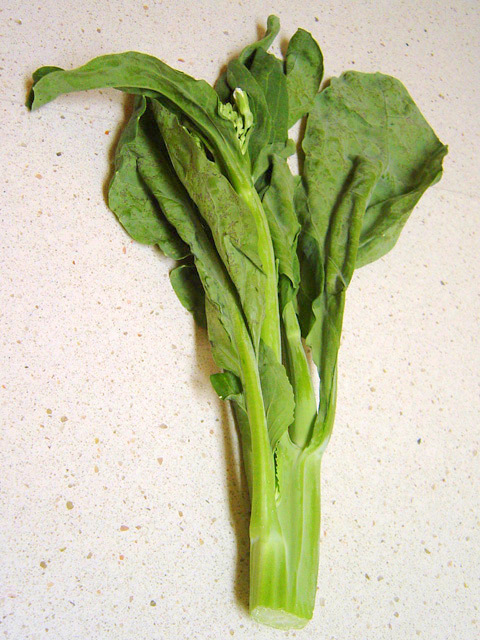
Broccoli chinese
Photo: Kowloonese CC BY-SA 3.0 via Wikimedia Commons
Nutrition per 100g
Full Nutrition Breakdown per 100g
Per 100 g, Broccoli, chinese, cooked contains 0.840 g of total sugars.
Per 100 g, Broccoli chinese also provides 0.560 mg iron, 100.0 mg calcium, 261.0 mg potassium, 18.0 mg magnesium, 0.390 mg zinc and 41.0 mg phosphorus.
Research findings
Each finding is a claim distilled from a published study, with an honest verdict on how strongly the wider literature backs it.
-
Glucosinolates and their breakdown products in sprouts of 22 Chinese kale (Brassica oleracea var. alboglabra) varieties were investigated using HPLC and GC-MS.
CorroboratedCohort study PMID 33965761 -
Relationships between glucosinolate metabolites and flavor of Chinese kale sprouts were analyzed.
CorroboratedCohort study PMID 33965761 -
Compositions and contents of glucosinolates and their breakdown products varied greatly among different varieties of Chinese kale sprouts.
CorroboratedCohort study PMID 33965761 -
Gluconapin was the dominant glucosinolate in Chinese kale sprouts.
CorroboratedCohort study PMID 33965761 -
4,5-Epithio-pentanenitrile was the dominant glucosinolate breakdown product in Chinese kale sprouts.
CorroboratedCohort study PMID 33965761 -
Significant differences were found among cultivar groups in glucosinolate proportions and in contents of alkyl, alkenyl and indole glucosinolates.
CorroboratedCohort study PMID 15053347
Showing the 6 most relevant corroborated findings of 1042. Search above to explore the rest.
Lab & mechanism studies (194)
-
Kai-lan (Chinese broccoli) contains abundant glucosinolates.
CorroboratedMechanistic PMID 21366048 -
Intact glucosinolates are believed to be inactive.
CorroboratedMechanistic PMID 21366048 -
Hydrolysis products of glucosinolates such as isothiocyanates (ITCs) have bacteriocidal and anticarcinogenic activities.
CorroboratedMechanistic PMID 21366048 -
The hydrolysis of broccolini seed glucosinolates was investigated under controlled conditions of pH, time and temperature.
CorroboratedMechanistic PMID 21366048 -
Optimum hydrolysis of glucosinolates could be achieved at a temperature of 25°C, at pH 7.0, and a reaction time of eight hours.
CorroboratedMechanistic PMID 21366048 -
GC-MS analysis indicated that the extracted ITCs primarily were 3-BITC (3-benzyl-ITC) (10.8%), 4-methylpentyl-ITC (0.5%), 1-isothiocyanato-butane (26.8%), PEITC (phenethyl-ITC) (22.6%) and SFN (sulforaphane) (19.2%).
CorroboratedMechanistic PMID 21366048 -
The chloroplast genome length of white-flower Chinese kale cv. Sijicutiao (SJCT) is 153,365 bp.
CorroboratedMechanistic PMID 37373434 -
The chloroplast genome length of yellow-flower Chinese kale cv. Fuzhouhuanghua (FZHH) is 153,420 bp.
CorroboratedMechanistic PMID 37373434 -
Both Chinese kale chloroplast genomes contained 87 protein-coding genes and eight rRNA genes.
CorroboratedMechanistic PMID 37373434 -
The SJCT Chinese kale chloroplast genome has 36 tRNA genes while the FZHH genome has 35 tRNA genes.
CorroboratedMechanistic PMID 37373434
Recipes with Broccoli chinese
No recipes use this food yet.
Built for nutritionists. See how it grows your practice →