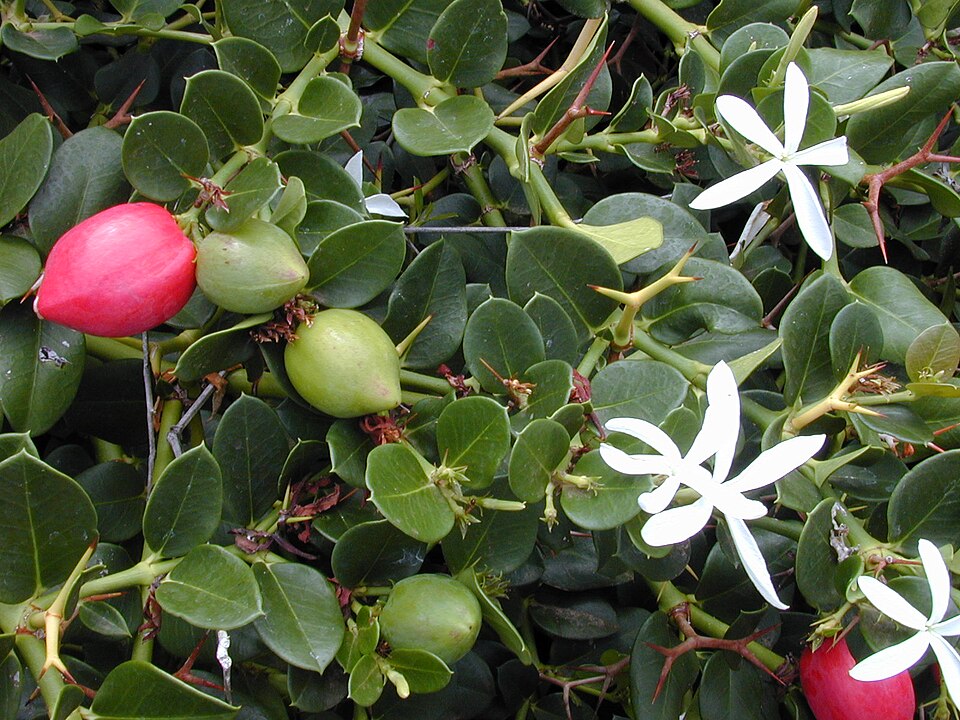
Photo: Forest & Kim Starr CC BY 3.0 via Wikimedia Commons
Nutrition per 100g
Full Nutrition Breakdown per 100g
Per 100 g, Carissa (natal-plum) also provides 1.3 mg iron, 11.0 mg calcium, 260.0 mg potassium, 16.0 mg magnesium, 7.0 mg phosphorus and 38.0 mg vitamin C.
Research findings
Each finding is a claim distilled from a published study, with an honest verdict on how strongly the wider literature backs it.
-
Element concentrations in Carissa macrocarpa fruit were found to be in the order Ca>Mg>Fe>Mn≈Cu≈Pb>Se>Cr>Ni>Zn.
CorroboratedCohort study PMID 22632042 -
Except for Pb, all of the elements found in Carissa macrocarpa fruit contribute significantly towards the recommended dietary allowances.
CorroboratedCohort study PMID 22632042 -
Carissa macrocarpa fruit was rich in monounsaturated and essential fatty acids.
CorroboratedCohort study PMID 22632042 -
The linoleic acid to α-linolenic acid ratio in Carissa macrocarpa fruit conformed to the recommended range for cardiac health.
CorroboratedCohort study PMID 22632042 -
Carissa macrocarpa fruit showed a tendency to accumulate Pb.
CorroboratedCohort study PMID 22632042 -
Site location had a major effect on Carissa macrocarpa plant element concentrations.
CorroboratedCohort study PMID 22632042 -
In Natal plum, the colour value a* (redness) was higher in the order of maturity stages M5 > M4 > M3 > M2 > M1.
CorroboratedCohort study PMID 31151641 -
In Natal plum, fruit weight was higher in the order of maturity stages M5 > M4 > M3 > M2 > M1.
CorroboratedCohort study PMID 31151641 -
In Natal plum, fruit size (length and width) was higher in the order of maturity stages M5 > M4 > M3 > M2 > M1.
CorroboratedCohort study PMID 31151641 -
In Natal plum, sugars (glucose and fructose) were higher in the order of maturity stages M5 > M4 > M3 > M2 > M1.
CorroboratedCohort study PMID 31151641
Showing the 10 most relevant corroborated findings of 266. Search above to explore the rest.
Lab & mechanism studies (86)
-
Cyanidin 3-sambubioside is the dominant anthocyanin in Natal plum (Carissa macrocarpa).
CorroboratedMechanistic PMID 35885359 -
Natal plum (Carissa macrocarpa) contains anthocyanins, cyanidin 3-O-β-sambubioside (Cy-3-Sa), and cyanidin 3-O-glucoside (Cy-3-G).
CorroboratedMechanistic PMID 36076736 -
The complete plastome sequence of Carissa macrocarpa was determined in this study.
CorroboratedMechanistic PMID 33473704 -
The gene order and structure of the Carissa macrocarpa plastome are similar to those of a typical angiosperm.
CorroboratedMechanistic PMID 33473704 -
The complete Carissa macrocarpa plastome is 155,297 bp in length.
CorroboratedMechanistic PMID 33473704 -
The Carissa macrocarpa plastome contains a large single-copy region of 85,586 bp.
CorroboratedMechanistic PMID 33473704 -
The Carissa macrocarpa plastome contains a small single-copy region of 18,131 bp.
CorroboratedMechanistic PMID 33473704 -
The large and small single-copy regions of the Carissa macrocarpa plastome are separated by two inverted repeats of 25,792 bp.
CorroboratedMechanistic PMID 33473704 -
The Carissa macrocarpa plastome contains 113 genes.
CorroboratedMechanistic PMID 33473704 -
Of the 113 genes in the Carissa macrocarpa plastome, 79 are protein-coding genes.
CorroboratedMechanistic PMID 33473704
Recipes with Carissa (natal-plum)
No recipes use this food yet.
Built for nutritionists. See how it grows your practice →