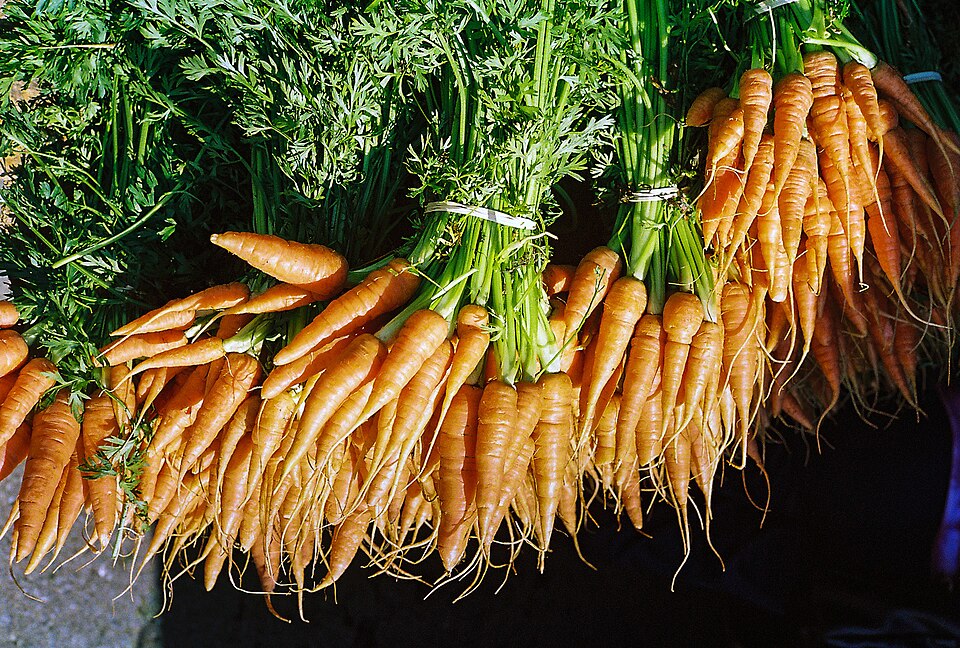
Photo: Robert Couse-Baker CC BY 2.0 via Wikimedia Commons
Nutrition per 100g
Full Nutrition Breakdown per 100g
Per 100 g, Carrots, frozen, unprepared contains 4.2 g of total sugars, led by sucrose and fructose.
Per 100 g, Carrot also provides 0.430 mg iron, 33.0 mg calcium, 210.0 mg potassium, 10.8 mg magnesium, 0.280 mg zinc and 31.0 mg phosphorus.
Origins & cultivation
- Top producing countries
- China · Uzbekistan · India
Production data: FAO FAOSTAT (2024) · CC BY 4.0
Research findings
Each finding is a claim distilled from a published study, with an honest verdict on how strongly the wider literature backs it.
-
Previous studies on the association between carrot intake and prostate cancer risk have reported inconsistent results.
CorroboratedSystematic review PMID 24519559 -
Carrots are main dietary sources of several potential anti-cancer compounds, including polyacetylenes.
CorroboratedSystematic review PMID 38104588 -
Epidemiological studies on the association between carrot consumption and lung cancer risk have produced inconsistent findings.
CorroboratedSystematic review PMID 31552816 -
For squamous cell carcinoma of the lung, the pooled OR for highest versus lowest carrot consumption was 0.52 (95% CI 0.19, 1.45).
CorroboratedSystematic review PMID 31552816 -
For small-cell carcinoma of the lung, the pooled OR for highest versus lowest carrot consumption was 0.43 (95% CI 0.12, 1.59).
CorroboratedSystematic review PMID 31552816 -
For large-cell carcinoma of the lung, the pooled OR for highest versus lowest carrot consumption was 0.40 (95% CI 0.10, 1.57).
CorroboratedSystematic review PMID 31552816 -
For combined squamous and small-cell carcinoma of the lung, the pooled OR for highest versus lowest carrot consumption was 0.85 (95% CI 0.45, 1.62).
CorroboratedSystematic review PMID 31552816 -
For combined adenocarcinoma and large-cell carcinoma of the lung, the pooled OR for highest versus lowest carrot consumption was 0.20 (95% CI 0.02, 1.70).
CorroboratedSystematic review PMID 31552816 -
Carrots represent the major dietary source of polyacetylenes.
CorroboratedRCT PMID 41314836 -
The interaction of carrot polyacetylenes with cancer cells and enzyme systems of animals and humans has been systematically investigated over the last 15 years.
CorroboratedRCT PMID 41314836
Showing the 10 most relevant corroborated findings of 1446. Search above to explore the rest.
Lab & mechanism studies (129)
-
Water-soluble anthocyanin obtained from carrot (Daucus carota) callus cultures was evaluated for antioxidant properties.
CorroboratedMechanistic PMID 12907406 -
Cyanidin-3-lathyroside was isolated as a major anthocyanin from carrot callus cultures.
CorroboratedMechanistic PMID 12907406 -
The results suggest that polyacetylenes, not anthocyanins, in purple carrots are responsible for anti-inflammatory bioactivity.
CorroboratedMechanistic PMID 18433135 -
Carrot (Daucus carota L.) is a nutritional source enriched with β-carotene at 0.01%.
CorroboratedMechanistic PMID 27068881 -
Daucus carota L. (carrot) is a traditionally consumed functional food that contains a high concentration of antioxidants, ascorbic acid, polyphenols, and numerous phytochemicals.
CorroboratedMechanistic PMID 37764365 -
α-carotene and β-carotene are the main carotenoids of carrots (Daucus carota).
CorroboratedMechanistic PMID 34512681 -
Bioinformatic analyses predicted potential mammalian targets of carrot miRNAs, focusing on genes involved in adipogenesis and lipid regulation.
CorroboratedMechanistic PMID 41010445 -
Predicted mammalian targets of carrot miRNAs include genes in the insulin and FoxO signaling pathways.
CorroboratedMechanistic PMID 41010445 -
Six stress-responsive carrot miRNAs were predicted to target mammalian lipid metabolism genes.
CorroboratedMechanistic PMID 41010445 -
Insoluble dietary fiber was extracted from carrot pomace.
CorroboratedMechanistic PMID 29622219
Recipes with Carrot
Built for nutritionists. See how it grows your practice →