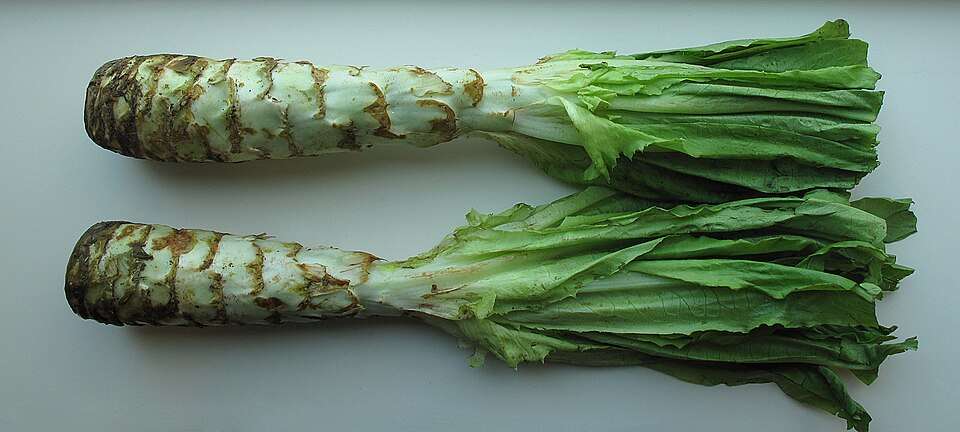
Celtuce
Photo: Downtowngal CC BY-SA 3.0 via Wikimedia Commons
Nutrition per 100g
Full Nutrition Breakdown per 100g
Per 100 g, Celtuce also provides 0.550 mg iron, 39.0 mg calcium, 330.0 mg potassium, 28.0 mg magnesium, 0.270 mg zinc and 39.0 mg phosphorus.
Research findings
Each finding is a claim distilled from a published study, with an honest verdict on how strongly the wider literature backs it.
-
Cd was more prone to be taken up, translocated and accumulated from soil to the lettuce plant than the other heavy metals.
CorroboratedCohort study PMID 35991400 -
The lowest nitrate content among the analyzed samples was detected in dandelion, with a mean value of 195 mg kg(-1).
CorroboratedCohort study PMID 24779737 -
Nitrate content in dandelion ranged from 47 to 487 mg kg(-1).
CorroboratedCohort study PMID 24779737 -
Nitrate content in lettuce of different origins ranged from 85 to 3237 mg kg(-1), with a mean value of 1196 mg kg(-1).
CorroboratedCohort study PMID 24779737 -
The mean nitrate content in organically cultivated lettuce was 890 mg kg(-1).
CorroboratedCohort study PMID 24779737 -
The mean nitrate content in conventionally cultivated lettuce was 1298 mg kg(-1).
CorroboratedCohort study PMID 24779737 -
Lettuce, scallion, cabbage, water spinach, garlic, and pea seedlings had antimony enrichment coefficients of 0.01-0.1, indicating good antimony absorption capacity.
CorroboratedCohort study PMID 35258220 -
Loofah, asparagus lettuce, pepper, carrot, bitter gourd, corn, eggplant, cowpea, and celery had antimony enrichment coefficients less than 0.01.
CorroboratedCohort study PMID 35258220
Showing the 8 most relevant corroborated findings of 605. Search above to explore the rest.
Lab & mechanism studies (177)
-
The S RNA of the orthotospovirus identified from celtuce is 3146 nt in length.
CorroboratedMechanistic PMID 29392494 -
The M RNA of the orthotospovirus identified from celtuce is 4734 nt in length.
CorroboratedMechanistic PMID 29392494 -
The L RNA of the orthotospovirus identified from celtuce is 8934 nt in length.
CorroboratedMechanistic PMID 29392494 -
The S RNA of the celtuce orthotospovirus shares 30.4-72.5% nucleotide sequence identity with known orthotospoviruses.
CorroboratedMechanistic PMID 29392494 -
The M RNA of the celtuce orthotospovirus shares 43.4-80.8% nucleotide sequence identity with known orthotospoviruses.
CorroboratedMechanistic PMID 29392494 -
The L RNA of the celtuce orthotospovirus shares 29.84-82.9% nucleotide sequence identity with known orthotospoviruses.
CorroboratedMechanistic PMID 29392494 -
The full-length nucleoprotein (N) of the celtuce orthotospovirus shares highest amino acid sequence identity (90.25%) with calla lily chlorotic spot virus isolated from calla lily (CCSV-calla).
CorroboratedMechanistic PMID 29392494 -
The full-length nucleoprotein (N) of the celtuce orthotospovirus shares highest amino acid sequence identity (90.25%) with calla lily chlorotic spot virus isolated from tobacco (CCSV-LJ1).
CorroboratedMechanistic PMID 29392494 -
Phylogenetic analyses showed that the celtuce orthotospovirus is phylogenetically associated with CCSV isolates.
CorroboratedMechanistic PMID 29392494 -
The celtuce orthotospovirus clustered with CCSV, tomato zonate spot virus (TZSV), and tomato necrotic spot-associated virus (TNSaV) in a separate sub-branch.
CorroboratedMechanistic PMID 29392494
Recipes with Celtuce
No recipes use this food yet.
Built for nutritionists. See how it grows your practice →