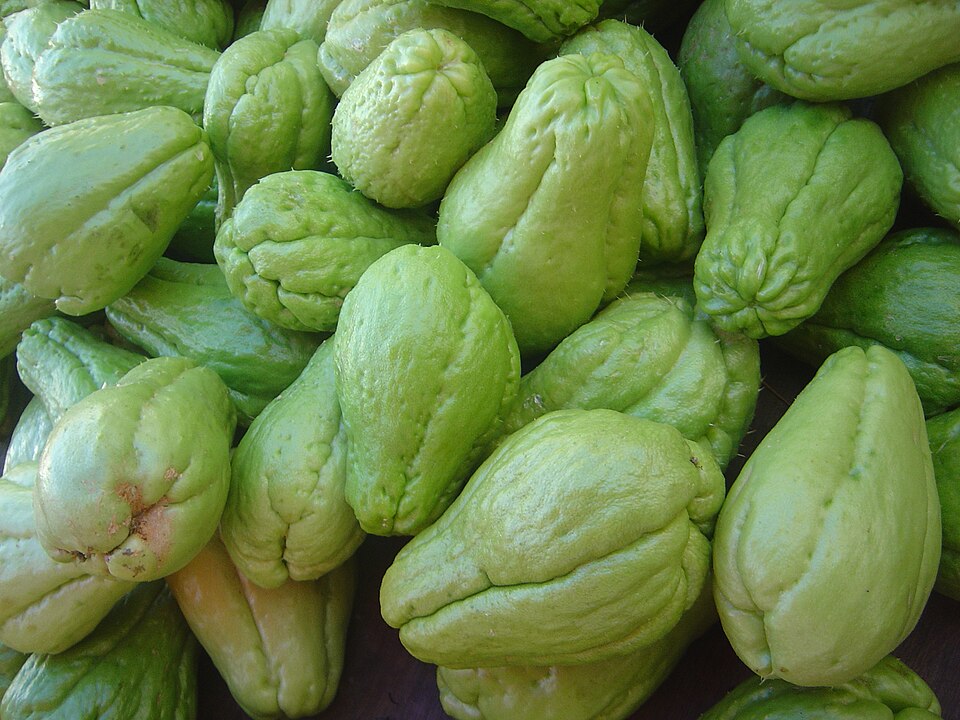
Photo CC BY-SA 3.0 via Wikimedia Commons
Nutrition per 100g
Full Nutrition Breakdown per 100g
Per 100 g, Chayote, fruit, cooked, boiled, drained, with salt contains 1.9 g of total sugars.
Per 100 g, Chayote also provides 0.220 mg iron, 13.0 mg calcium, 173.0 mg potassium, 12.0 mg magnesium, 0.310 mg zinc and 29.0 mg phosphorus.
Research findings
Each finding is a claim distilled from a published study, with an honest verdict on how strongly the wider literature backs it.
-
Different parts of the chayote plant (fruits, leaves, seeds, tuberous roots, and peels) contain diverse bioactive compounds including flavonoids, phenolic acids, cucurbitacins, pectin polysaccharides, and carotenoids.
CorroboratedSystematic review PMID 42737226 -
Chayote has reported bioactivities including antioxidant, anti-inflammatory, hypoglycemic, cardioprotective, antiproliferative, and geroprotective effects.
CorroboratedSystematic review PMID 42737226 -
Chayote's bioactivities are mediated in part through Nrf2-mediated antioxidant signaling and sirtuin (SIRT1/3/5/6) upregulation.
CorroboratedSystematic review PMID 42737226 -
Recent genomic work on chayote revealed a chromosome-level genome assembly, whole-genome duplication events, and a domestication history tracing to Mexico's Oaxaca region.
CorroboratedSystematic review PMID 42737226 -
Anti-proliferative activity of Sechium spp. extracts was assessed on five malignant cell lines.
CorroboratedSystematic review PMID 33731771 -
Significant relationships were obtained between morphological and biochemical characters and anti-proliferative activity in cell lines for Sechium spp.
CorroboratedSystematic review PMID 33731771 -
Patients with metabolic syndrome have a redox imbalance due to a decay in antioxidant capacity.
CorroboratedRCT PMID 32708368 -
Oxidative stress is considered an important modulator of telomere shortening and telomerase activity.
CorroboratedRCT PMID 32708368 -
The underlying molecular mechanisms of the hypoglycemic effects of Sechium edule var. nigrum spinosum remain unknown.
CorroboratedRCT PMID 41976223 -
The sirtuin-mediated signaling cascade responds to various stressors such as oxidative stress and regulates glucose metabolism.
CorroboratedRCT PMID 41976223
Showing the 10 most relevant corroborated findings of 1159. Search above to explore the rest.
Lab & mechanism studies (187)
-
Chayote fruits, leaves and tuberous roots contain complex carbohydrates as dietary fiber and starch, vitamins and minerals.
CorroboratedMechanistic PMID 26076612 -
The complex polysaccharides (cell walls and starch) were analyzed in the black and green varieties of chayote fruits as well as in green chayote tuberous root before and after a controlled cooking process.
CorroboratedMechanistic PMID 26076612 -
Pectins homogalacturonans and rhamnogalacturonan I backbones constitute about 15-20% of the chayote wall mass.
CorroboratedMechanistic PMID 26076612 -
Chayote pectins are heavily substituted with up to 60% neutral arabinans, galactans, and arabinogalactans.
CorroboratedMechanistic PMID 26076612 -
The remainder of chayote cell-wall polysaccharides is composed of xyloglucan, glucomannans and galactoglucomannans.
CorroboratedMechanistic PMID 26076612 -
Chayote tuberous roots constitute a valuable additional source of quality starch and fiber.
CorroboratedMechanistic PMID 26076612 -
Soy protein and xanthan gum primarily influenced the moisture content of fresh-coated chayote, which ranged from 5.44% to 9.93%.
CorroboratedMechanistic PMID 38672851 -
Pectin influenced the water activity of fresh-coated chayote.
CorroboratedMechanistic PMID 38672851 -
Pectin affected the water activity and rehydration of blanch-coated chayote.
CorroboratedMechanistic PMID 38672851 -
The parabolic model for thin-layer materials achieved the best fit (R2: 0.996 to 0.999) for the drying kinetics of chayote.
CorroboratedMechanistic PMID 38672851
Recipes with Chayote
No recipes use this food yet.
Built for nutritionists. See how it grows your practice →