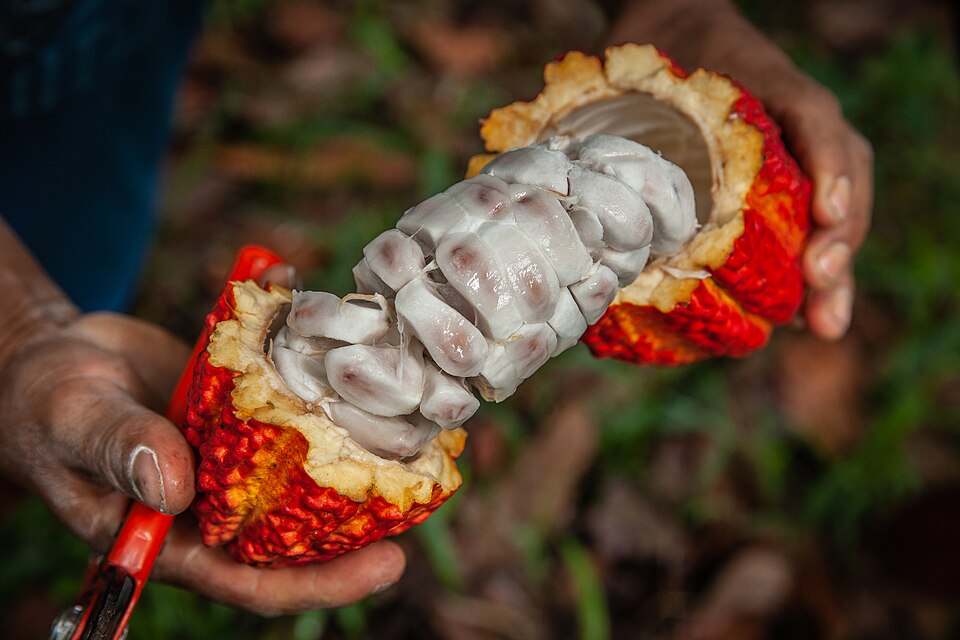
Photo: USAID Digital Development CC BY 2.0 via Wikimedia Commons
Nutrition per 100g
Full Nutrition Breakdown per 100g
Per 100 g, Cocoa, dry powder, hi-fat or breakfast, processed with alkali contains 1.5 g of total sugars. Its fat is mostly saturated.
Per 100 g, Cocoa also provides 14.5 mg iron, 122.0 mg calcium, 2510.0 mg potassium, 476.0 mg magnesium, 6.7 mg zinc and 758.0 mg phosphorus.
Origins & cultivation
- Origin
- Amazon rainforest
- Top producing countries
- Côte d'Ivoire · Indonesia · Ghana
- About
- tree native to tropical South America producing cocoa beans - the source plant of cacao and chocolate Read more on Wikipedia ↗
Production data: FAO FAOSTAT (2024) · CC BY 4.0
Research findings
Each finding is a claim distilled from a published study, with an honest verdict on how strongly the wider literature backs it.
-
Cocoa with more than 30% canopy cover from diverse trees held a different community of birds than nearby primary or mature secondary forest.
CorroboratedSystematic review PMID 34061388 -
Of 32 cocoa product samples analyzed, the two food supplements delivered 900 mg of total flavanols and 100 mg epicatechin in doses of 7 g and 20 g and 3 and 8 g, respectively.
CorroboratedSystematic review PMID 27363823 -
Cocoa and dark chocolate are abundant dietary sources of polyphenols.
CorroboratedSystematic review PMID 42641106 -
To achieve 900 mg flavanols with chocolate, around 100 to 500 g would need to be consumed.
CorroboratedSystematic review PMID 27363823 -
To achieve 100 mg epicatechin with chocolate, around 50 to 200 g would need to be consumed.
CorroboratedSystematic review PMID 27363823 -
Each 419-kJ chocolate bar was nutrient-matched and contained approximately 180 mg cocoa flavanols.
CorroboratedRCT PMID 18356327 -
Cocoa may have prebiotic effects and improve gut barrier function.
CorroboratedRCT PMID 39693929 -
The blood pressure and endothelial effects of cocoa are attributed to the action of cocoa polyphenols.
CorroboratedRCT PMID 17609490 -
Dark chocolate and cocoa contain flavanols.
CorroboratedRCT PMID 42320568 -
Each chocolate bar contained 1.1 g sterol esters.
CorroboratedRCT PMID 18356327
Showing the 10 most relevant corroborated findings of 1259. Search above to explore the rest.
Lab & mechanism studies (65)
-
Both cocoa and chocolate contain monomeric and oligomeric procyanidin units 2-10.
CorroboratedMechanistic PMID 10563922 -
The first 48 h of fermentation significantly determined the composition of the methylxanthines and polyphenols in the cocoa beans.
CorroboratedMechanistic PMID 32662271 -
Fermentation for 72 h retained considerable amounts of methylxanthines and polyphenols in the beans while producing cocoa mass with good sensory profiles.
CorroboratedMechanistic PMID 32662271 -
The origin and post-harvest processes affect the chemical and volatile composition of cocoa beans.
CorroboratedMechanistic PMID 40226994 -
Chemical profiles allowed differentiation between cocoa varieties.
CorroboratedMechanistic PMID 40226994 -
Cocoa powder derived from the Theobroma cacao plant is rich in polyphenols such as catechin and epicatechin.
CorroboratedMechanistic PMID 39429210 -
Cocoa polyphenols are strong antioxidants when consumed orally.
CorroboratedMechanistic PMID 39429210 -
Higher epicatechin levels than catechin levels were detected from the cocoa powder at both time points.
CorroboratedMechanistic PMID 39429210 -
Cocoa honey is a yellow liquid that drips from cocoa beans.
CorroboratedMechanistic PMID 39967153 -
Cocoa honey is rich in sugars, organic acids, vitamins, and minerals, making it highly susceptible to microbial fermentation.
CorroboratedMechanistic PMID 39967153
Recipes with Cocoa
Built for nutritionists. See how it grows your practice →