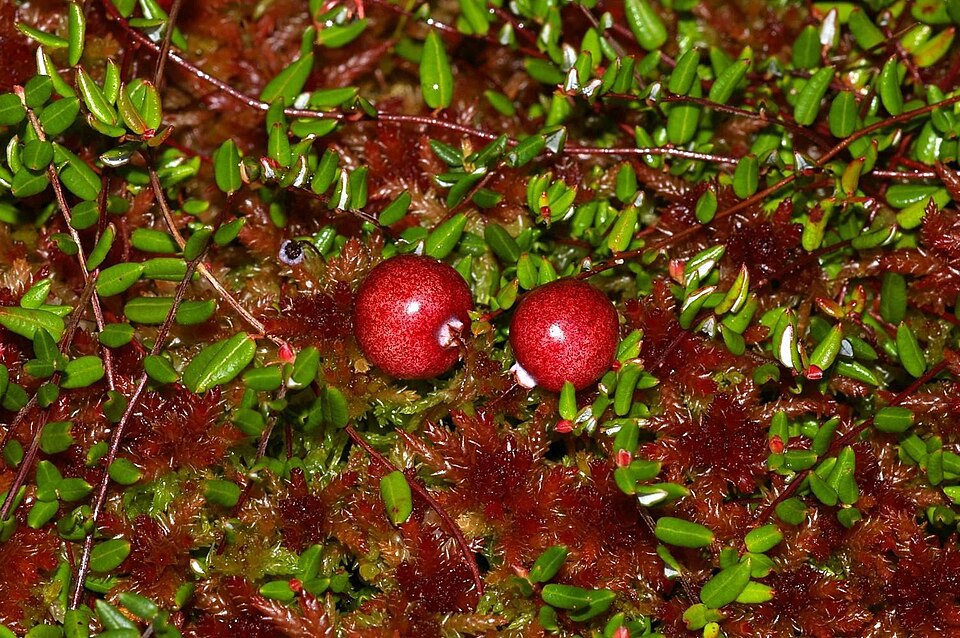
Cranberries (Alaska Native)
Photo: Christian Fischer CC BY-SA 3.0 via Wikimedia Commons
Nutrition per 100g
Full Nutrition Breakdown per 100g
Per 100 g, Cranberries (Alaska Native) also provides 1.0 mg iron, 20.0 mg calcium, 140.0 mg potassium, 15.0 mg phosphorus, 15.0 mg vitamin C and 1060.0 International Unit vitamin A.
Origins & cultivation
- Top producing countries
- United States of America · Canada · Azerbaijan
Production data: FAO FAOSTAT (2024) · CC BY 4.0
Research findings
Each finding is a claim distilled from a published study, with an honest verdict on how strongly the wider literature backs it.
-
Cranberries are rich in polyphenols including proanthocyanidins, chlorogenic acid, flavonols, anthocyanins, and caffeic acid.
CorroboratedSystematic review PMID 41096972 -
Cranberries contain triterpenoids and other nutrients.
CorroboratedSystematic review PMID 41096972 -
Cranberries are named for their richness in a variety of mineral elements, trace elements and vitamins.
CorroboratedSystematic review PMID 41096972 -
Cranberry extracts are composed of proanthocyanidins.
CorroboratedSystematic review PMID 36495398 -
Blueberry and cranberry are rich in polyphenols.
CorroboratedSystematic review PMID 35282984 -
Cranberries contain proanthocyanidins (PACs).
CorroboratedSystematic review PMID 37068952 -
Cranberries contain proanthocyanidins (PACs).
CorroboratedSystematic review PMID 37947276 -
Cranberry and grape seed extracts or their fractions decreased polymicrobial biofilm biomass.
CorroboratedSystematic review PMID 38840232 -
Cranberry and grape seed extracts showed adequate antioxidant activity related to polyphenol content.
CorroboratedSystematic review PMID 38840232 -
Cranberry and grape seed extracts were effective in reducing the virulence factors of the oral pathogen.
CorroboratedSystematic review PMID 38840232
Showing the 10 most relevant corroborated findings of 2313. Search above to explore the rest.
Lab & mechanism studies (132)
-
Vaccinium oxycoccos and Vaccinium macrocarpon both contain the 5 major anthocyanins known in cranberry.
CorroboratedMechanistic PMID 22337317 -
Approximately 8000-10 000 phytochemicals were detected in each cranberry species.
CorroboratedMechanistic PMID 22337317 -
Multivariate modeling differentiated the cranberry species.
CorroboratedMechanistic PMID 22337317 -
Cranberry and lingonberry concentrates were added to commercial sugar-reduced fruit spreads (raspberry-Aloe vera, strawberry-guava, and strawberry-lime) and tested for antifungal activities.
CorroboratedMechanistic PMID 25868124 -
Cranberries (Vaccinium macrocarpon) are an important source of anthocyanins, flavan-3-ols and flavonols.
CorroboratedMechanistic PMID 33642004 -
Hemagglutination induced by Streptococcus suis was most effectively inhibited by cranberry fraction FII.
CorroboratedMechanistic PMID 19610031 -
The inhibitory activity of cranberry (Vaccinium oxycoccos L.), bilberry, and crowberry juice fractions against pneumococcal binding was tested using human bronchial cells (Calu-3) as an adhesion model.
CorroboratedMechanistic PMID 20625989 -
Cranberry, bilberry, and crowberry juices have potential against pneumococcal infections.
CorroboratedMechanistic PMID 20625989 -
European, small-fruited cranberries (Vaccinium microcarpon) and lingonberries (Vaccinium vitis-idaea) were characterized for their phenolic compounds.
CorroboratedMechanistic PMID 21370878 -
European, small-fruited cranberries and lingonberries were tested for antioxidant, antimicrobial, antiadhesive, and antiinflammatory effects.
CorroboratedMechanistic PMID 21370878
Recipes with Cranberries (Alaska Native)
No recipes use this food yet.
Built for nutritionists. See how it grows your practice →