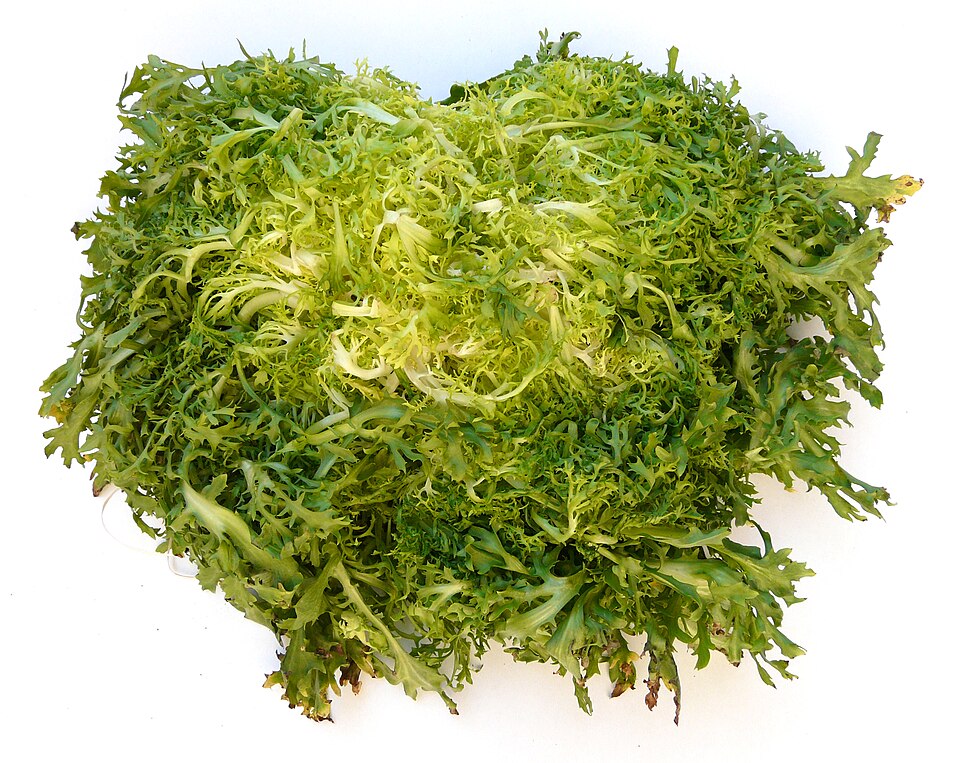
Photo: Photograph: Frank C. Müller , Baden-Baden CC BY-SA 3.0 via Wikimedia Commons
Nutrition per 100g
Full Nutrition Breakdown per 100g
Per 100 g, Endive, raw contains 0.250 g of total sugars.
Per 100 g, Endive also provides 0.830 mg iron, 52.0 mg calcium, 314.0 mg potassium, 15.0 mg magnesium, 0.790 mg zinc and 28.0 mg phosphorus.
Origins & cultivation
- Top producing countries
- China · United States of America · India
- About
- species of plant Read more on Wikipedia ↗
Production data: FAO FAOSTAT (2024) · CC BY 4.0
Research findings
Each finding is a claim distilled from a published study, with an honest verdict on how strongly the wider literature backs it.
-
Broad-leaved endive (Cichorium endivia var. latifolia) harbors biofilms containing fluorescent pseudomonads.
CorroboratedCohort study PMID 15259273 -
Within a given area, sterol content was similar in smooth- and curly-leafed endives, ranging from 106.3 to 176.0 mg/kg FW.
CorroboratedCohort study PMID 27575665 -
In endive leaves, sitosterol and stigmasterol were the major sterol fractions, at 45-56% and 38-43% respectively.
CorroboratedCohort study PMID 27575665 -
Biofilms are likely to influence the microenvironment and phenotype of the microorganisms they harbor.
CorroboratedCohort study PMID 15259273 -
Gram-positive bacteria tended to occur more frequently within biofilms than outside of biofilms.
CorroboratedCohort study PMID 15259273 -
Leaf colonization by fluorescent pseudomonads is suggested to involve a flux of cells between biofilm and solitary states.
CorroboratedCohort study PMID 15259273 -
Biofilms would favor resistance to stressful conditions, whereas solitary cells could foster spread of bacteria to newly colonizable sites on leaves.
CorroboratedCohort study PMID 15259273 -
Factors other than an increase in concentration of airborne bacteria can lead to increases in bacterial population sizes at leaf emergence as plants age in the field.
CorroboratedCohort study PMID 16534973 -
Interactions among micro- and macroenvironmental conditions, physiological condition of leaves, and accessibility of leaves to airborne bacteria are important in controlling epiphytic bacterial population sizes.
CorroboratedCohort study PMID 16534973 -
A novel ion chromatographic method was developed to detect nitrates in vegetables.
CorroboratedCohort study PMID 13129772
Showing the 10 most relevant corroborated findings of 1093. Search above to explore the rest.
Lab & mechanism studies (177)
-
Endives are rich in sesquiterpene lactones (STL) that exert proven function on bitter taste and human health.
CorroboratedMechanistic PMID 30603088 -
Twenty-six genes in the sesquiterpenoid biosynthesis pathway were identified in endives, including GAS/GAO/COS module members required for costunolide synthesis.
CorroboratedMechanistic PMID 30603088 -
Chicory (Cichorium intybus L. var. foliosum, Belgian endive) is rich in protocatechuic acid.
CorroboratedMechanistic PMID 26075340 -
Eight varieties of lettuce (Lactuca sativum) and three varieties of endive (Cichorium endivia) were analyzed for flavonoid composition and content.
CorroboratedMechanistic PMID 10995297 -
Total flavonoid contents of endive ranged from 44 to 248 microg/g expressed as aglycon for fresh material.
CorroboratedMechanistic PMID 10995297 -
Three kaempferol conjugates (kaempferol 3-O-glucoside, kaempferol 3-O-glucuronide, and kaempferol 3-O-[6-O-malonyl)glucoside]) were measured in each of the endive varieties.
CorroboratedMechanistic PMID 10995297 -
The presence and identity of kaempferol 3-O-(6-O-malonyl)glucoside in endive was shown for the first time.
CorroboratedMechanistic PMID 10995297 -
Storage of whole heads of endive in the dark at 1 degrees C and 98% humidity for 7 days resulted in losses of total flavonol glycosides.
CorroboratedMechanistic PMID 10995297 -
The endive genome was shaped by whole genome triplication (WGT-1).
CorroboratedGWAS PMID 35751596 -
The genome size difference between chicory and endive is largely due to LTR retrotransposons.
CorroboratedGWAS PMID 35751596
Recipes with Endive
Built for nutritionists. See how it grows your practice →