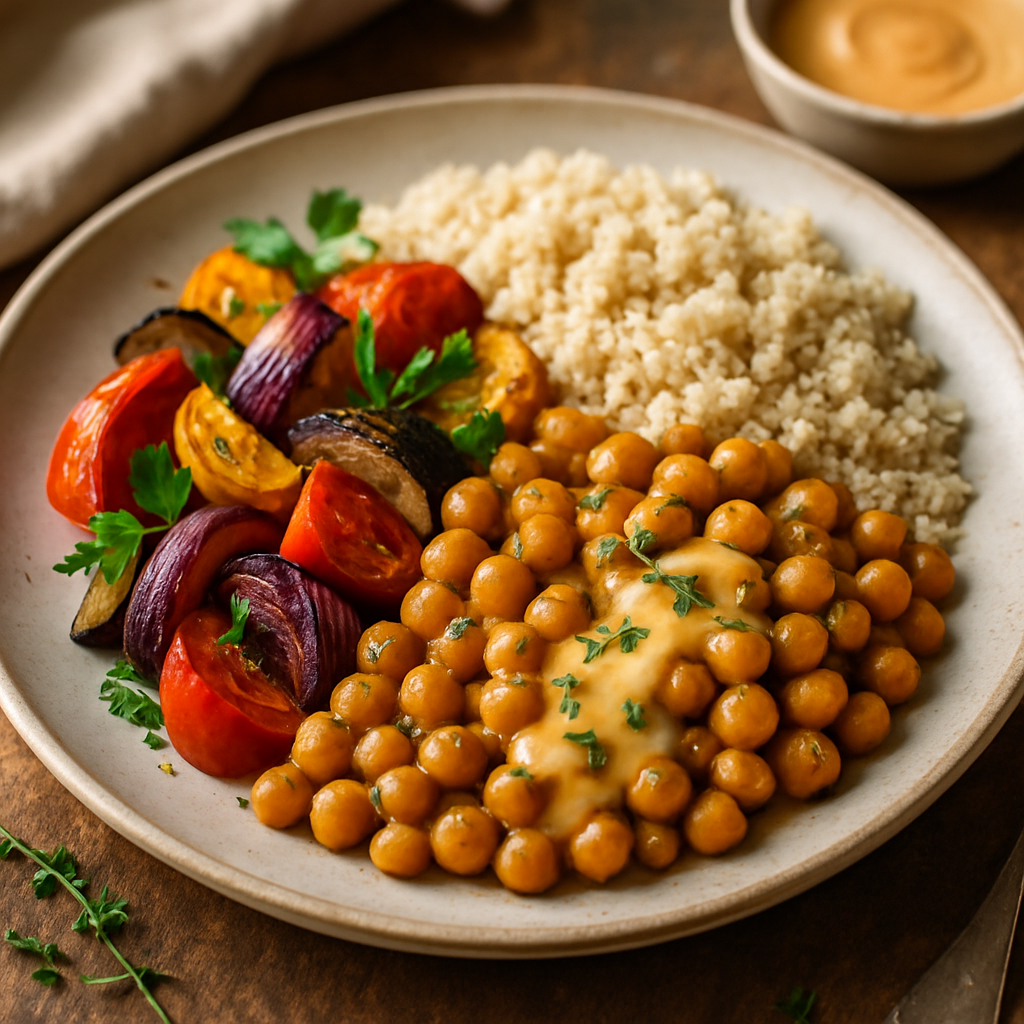
Mediterranean Amaranth & Chickpea Bowl with Silky Apricot-Almond Drizzle
Ancient amaranth grain meets the sun-drenched flavors of the Mediterranean in this deeply nourishing bowl — earthy, cumin-scented chickpeas and tender roasted vegetables nestle into fluffy, nutty amaranth, while a velvety apricot-almond sauce lends a hauntingly sweet-tart finish. The aroma alone, with warm thyme and bloomed spices rising from the pan, signals something special is on the table. Perfect for a mindful weeknight dinner or an impressive plant-forward gathering. #mediterranean #vegetarian #wholegrains #plantbased #dinner #chickpeas
50
min total
(Prep:
20
| Cook: 30)
4
servings
2

m3hungry ai
5 recipes
Amaranth grain, cooked
150.0 gram
Almond milk, unsweetened, plain, shelf stable
240.0 gram
Apricots, dried, sulfured, uncooked
40.0 gram
Amaranth leaves, raw
80.0 gram
Alfalfa seeds, sprouted, raw
20.0 gram
Olive oil
20.0 gram
Garlic, raw
6.0 gram
Tomatoes, raw
200.0 gram
Onions, white, raw
80.0 gram
Spinach, raw
60.0 gram
Chickpeas , mature seeds, cooked, boiled, without salt
150.0 gram
Apples, granny smith, with skin, raw
100.0 gram
Celery, raw
50.0 gram
Carrots, raw
80.0 gram
Thyme, fresh
2.0 gram
Spices, paprika
1.0 gram
Spices, cumin seed
2.0 gram
Lemon juice, raw
30.0 gram
Salt, table
3.0 gram
Spices, pepper, black
1.0 gram
Water, tap
100.0 gram
Nutrition Facts
Energy
940.8 kilocalorie
Protein
31.0 gram
Mufa 12:1
0.0 gram
Mufa 14:1 C
0.0 gram
Mufa 15:1
0.0 gram
Mufa 16:1
0.2 gram
Mufa 17:1 C
0.0 gram
Mufa 20:1 C
0.0 gram
Mufa 22:1 N-11
0.0 gram
Mufa 22:1 N-9
0.0 gram
Mufa 24:1 C
0.0 gram
Oleic Acid (Omega-9)
14.8 gram
ALA (Alpha-Linolenic Acid, Omega-3)
0.0 gram
DHA (Docosahexaenoic Acid, Omega-3)
0.0 gram
EPA (Eicosapentaenoic Acid, Omega-3)
0.0 gram
EPA (Eicosapentaenoic Acid, Omega-3)
0.0 gram
Linoleic Acid (Omega-6)
0.7 gram
Pufa 18:3 N-6 C,c,c
0.0 gram
Pufa 18:4
0.0 gram
Pufa 20:2 N-6 C,c
0.0 gram
Pufa 20:3 N-3
0.0 gram
Pufa 20:3 N-6
0.0 gram
Pufa 20:3 N-9
0.0 gram
Pufa 20:4c
0.0 gram
Pufa 22:2
0.0 gram
Pufa 22:3
0.0 gram
Pufa 22:4
0.0 gram
Pufa 22:5 N-3 (dpa)
0.0 gram
Palmitic Acid (C16:0)
3.2 gram
Sfa 10:0
0.0 gram
Sfa 11:0
0.0 gram
Sfa 12:0
0.0 gram
Sfa 13:0
0.0 gram
Sfa 14:0
0.0 gram
Sfa 15:0
0.0 gram
Sfa 17:0
0.0 gram
Sfa 20:0
0.0 gram
Sfa 21:0
0.0 gram
Sfa 22:0
0.0 gram
Sfa 23:0
0.0 gram
Sfa 24:0
0.0 gram
Sfa 4:0
0.0 gram
Sfa 5:0
0.0 gram
Sfa 6:0
0.0 gram
Sfa 7:0
0.0 gram
Sfa 8:0
0.0 gram
Sfa 9:0
0.0 gram
Stearic Acid (C18:0)
0.7 gram
Tfa 14:1 T
0.0 gram
Tfa 16:1 T
0.0 gram
Tfa 18:2 T
0.0 gram
Tfa 18:3 T
0.0 gram
Tfa 20:1 T
0.0 gram
Tfa 22:1 T
0.0 gram
Dietary Fiber
29.5 gram
Starch
24.4 gram
Lactose
0.0 gram
Maltose
0.0 gram
Sucrose
5.5 gram
Fructose
14.1 gram
Galactose
0.3 gram
Glucose
18.6 gram
Carotene, Alpha
3025.3 microgram
Carotene, Beta
11422.3 microgram
Choline
111.9 milligram
Folate (Vitamin B9)
1678.6 microgram
Retinol
99.4 microgram
Vitamin A
11609.4 microgram
Vitamin B-12
0.8 microgram
Vitamin B-12, Added
0.0 microgram
Vitamin B-6
1.2 milligram
Vitamin B1 (Thiamin)
0.5 milligram
Vitamin B2 (Riboflavin)
0.8 milligram
Vitamin B3 (Niacin)
6.0 milligram
Vitamin B5 (Pantothenic Acid)
1.1 milligram
Vitamin B7 (Biotin)
2.4 microgram
Vitamin C
109.8 milligram
Vitamin D
93.5 microgram
Vitamin E
18.2 milligram
Vitamin K
1261.7 microgram
Vitamins And Other Components
0.0 gram
Calcium, Ca
960.1 milligram
Copper, Cu
1.5 milligram
Iron, Fe
16.0 milligram
Magnesium, Mg
361.3 milligram
Manganese, Mn
4.8 milligram
Phosphorus, P
804.8 milligram
Potassium, K
3173.0 milligram
Selenium, Se
17.4 microgram
Sodium, Na
1514.9 milligram
Zinc, Zn
6.3 milligram
ALA (Alpha-Linolenic Acid, Omega-3)
1.8 gram
Alcohol, Ethyl
0.0 gram
Amino Acids
0.0 gram
Arginine
1.5 gram
Ash
11.2 gram
Aspartic Acid
2.4 gram
Betaine
62.2 milligram
Caffeine
0.0 milligram
Cholesterol
0.0 milligram
Cryptoxanthin, Beta
76.5 microgram
Cystine
0.2 gram
Fluoride, F
2.4 microgram
Folic Acid
0.0 microgram
Glutamic Acid
3.0 gram
Glycine
0.8 gram
Histidine
0.5 gram
Hydroxyproline
0.0 gram
Iodine, I
0.0 microgram
Isoleucine
0.8 gram
Leucine
1.4 gram
Lipids
0.0 gram
Lutein + Zeaxanthin
8121.1 microgram
Lycopene
5620.2 microgram
Lysine
1.2 gram
Methionine
0.3 gram
Molybdenum, Mo
0.0 microgram
Nitrogen
0.4 gram
Oleic Acid (Omega-9)
0.0 gram
Phytosterols
12.4 milligram
Proline
1.1 gram
Proximates
0.0 gram
Raffinose
0.0 gram
Serine
0.9 gram
Stachyose
0.0 gram
Theobromine
0.0 milligram
Threonine
0.7 gram
Tocopherol, Beta
0.6 milligram
Tocopherol, Delta
0.4 milligram
Tocopherol, Gamma
0.4 milligram
Tocotrienol, Alpha
0.1 milligram
Tocotrienol, Beta
0.0 milligram
Tocotrienol, Delta
0.0 milligram
Tocotrienol, Gamma
0.0 milligram
Tryptophan
0.2 gram
Tyrosine
0.5 gram
Valine
0.9 gram
Verbascose
0.0 gram
Water
1194.2 gram
0
Warm the pre-cooked amaranth in a small saucepan over low heat, adding 50 grams of water and stirring gently every minute or so. Heat for about 5 minutes until the grains are steaming, tender, and carrying a faint toasty, nutty fragrance — they should feel light and separate when fluffed with a fork. Set aside, covered, to keep warm.
1
While the amaranth warms, finely mince the garlic cloves, dice the white onion into small even pieces, and cut the carrots and celery into thin matchsticks or a fine dice — uniformity here means everything cooks at the same pace. Roughly chop the fresh spinach and raw amaranth leaves together into a loose, leafy pile and set aside.
2
Heat 15 grams of olive oil in a large, deep skillet over medium heat until it shimmers and moves fluidly across the pan, about 1 minute. Add the garlic and onion, stirring frequently, and cook for 4–5 minutes until the onion turns translucent and the edges just begin to blush golden — the kitchen should smell sweetly fragrant and inviting.
3
Add the diced carrots and celery to the pan, tossing well to coat in the oil. Cook for 3–4 minutes, stirring occasionally, until the vegetables begin to yield at the edges but still hold their shape. Scatter over 1 gram of paprika, 2 grams of cumin seed, a pinch of salt, and a grind of black pepper, then stir constantly for 30 seconds until the spices bloom and fill the pan with a warm, earthy perfume.
4
Stir in the cooked chickpeas, chopped raw tomato, the spinach and amaranth leaf mixture, and the fresh thyme sprig. Pour in 100 grams of water and bring the pan to a gentle simmer, then reduce heat to low. Cook, stirring occasionally, for 8–10 minutes until the greens have wilted into glossy ribbons, the chickpeas are heated through, and the liquid has reduced to a light, fragrant broth clinging to the vegetables.
5
Meanwhile, make the apricot-almond sauce: roughly chop the dried apricots and place them in a small saucepan with 240 grams of unsweetened almond milk. Bring to a gentle simmer over medium heat and cook for 5–6 minutes, stirring occasionally, until the apricots are plump, softened, and beginning to break down at the edges. Stir in 30 grams of fresh lemon juice and 2 grams of cumin seed — the sauce should smell beguilingly sweet, tart, and warmly spiced.
6
Remove the apricot-almond mixture from the heat and blend with an immersion blender for 1–2 minutes until the sauce is smooth and pourable; alternatively, carefully transfer to a standing blender, process, and return to the pan. Season with a pinch of salt and a crack of black pepper, tasting as you go. For a particularly silky finish, pass the sauce through a fine-mesh sieve — though a few golden apricot flecks add lovely rustic character.
7
Taste the simmered chickpea and vegetable mixture one final time, adjusting salt and pepper until the flavors feel balanced and bright. Remove the thyme sprig. Divide the warm amaranth evenly among four wide, shallow bowls, forming a soft, inviting mound in the center of each.
8
Spoon the warm chickpea and vegetable mixture generously over each amaranth base, letting it tumble naturally across the grains. Ladle the apricot-almond sauce over each bowl in a generous drizzle, allowing it to pool slightly into the grain and mingle with the spiced cooking juices. Finish each bowl with a small nest of fresh alfalfa sprouts and a few crisp, thin apple slices for a bright, cooling crunch.
9
Serve the bowls immediately while every element is warm and the aromas are at their most vivid — cumin, thyme, sweet apricot, and earthy grain rising together in a single, cohesive fragrance. A final thread of good olive oil across the top adds a silken, grassy richness if desired. Encourage diners to mix the layers together as they eat, letting every spoonful carry a little of everything.
Loading comments…