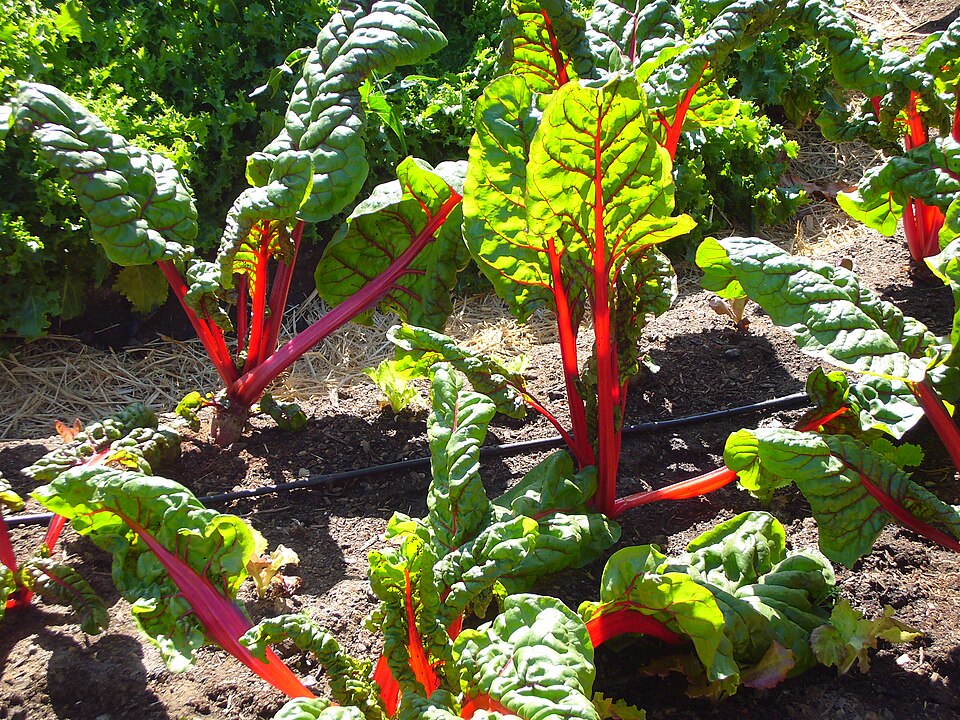
Photo: mercedesfromtheeighties CC BY-SA 2.0 via Wikimedia Commons
Nutrition per 100g
Πλήρης ανάλυση διατροφής ανά 100g
Per 100 g, Chard, swiss, cooked, boiled, drained, with salt contains 1.1 g of total sugars.
Per 100 g, Σέσκλο also provides 2.3 mg iron, 58.0 mg calcium, 549.0 mg potassium, 86.0 mg magnesium, 0.330 mg zinc and 33.0 mg phosphorus.
Research findings
Each finding is a claim distilled from a published study, with an honest verdict on how strongly the wider literature backs it.
-
A total of 192 chemical compounds categorized into 23 groups were found in Swiss chard.
CorroboratedSystematic review PMID 32746613 -
Nutrients and phytochemicals of Swiss chard were reported mainly on leaves.
CorroboratedSystematic review PMID 32746613 -
Betalains accounted for 20% of the reported data on Swiss chard composition.
CorroboratedSystematic review PMID 32746613 -
Fats accounted for 16% of the reported data on Swiss chard composition.
CorroboratedSystematic review PMID 32746613 -
Flavonoids accounted for 11% of the reported data on Swiss chard composition.
CorroboratedSystematic review PMID 32746613 -
Non-flavonoid phenolics accounted for 11% of the reported data on Swiss chard composition.
CorroboratedSystematic review PMID 32746613 -
Terpenes and derivatives accounted for 8% of the reported data on Swiss chard composition.
CorroboratedSystematic review PMID 32746613 -
Carbohydrates accounted for 7% of the reported data on Swiss chard composition.
CorroboratedSystematic review PMID 32746613 -
Minerals accounted for 6% of the reported data on Swiss chard composition.
CorroboratedSystematic review PMID 32746613 -
Swiss chard leaves have the highest content of fiber, sodium, magnesium, flavonoids, and vitamin C.
CorroboratedSystematic review PMID 32746613
Showing the 10 most relevant corroborated findings of 2097. Search above to explore the rest.
Εργαστηριακές & μηχανιστικές μελέτες (189)
-
Swiss chard (Beta vulgaris ssp. vulgaris var. cicla) and its wild ancestor sea beet (Beta vulgaris ssp. maritima) were cultivated hydroponically in nutrient solutions enriched with four iodine concentrations (0, 0.5, 1.0, and 1.5 mg L-1).
CorroboratedMechanistic PMID 37483122 -
The optimal iodine level in the nutrient solution was 1.0 mg L-1 for Swiss chard.
CorroboratedMechanistic PMID 37483122 -
The diversification of Swiss chard cultivars has resulted in differences in metabolite profiles.
CorroboratedMechanistic PMID 41674682 -
Sixty-three metabolites were identified in four Swiss chard cultivars with different leaf petiole colours using HPLC, GC-qMS, and GC-TOFMS.
CorroboratedMechanistic PMID 41674682 -
In addition to flavonoids, metabolomic data and antioxidant assays identified non-flavonoid metabolites such as policosanol, carotenoids, and glutamic acid derivatives as strong antioxidant candidates in Swiss chard.
CorroboratedMechanistic PMID 41674682 -
Policosanol, carotenoids, and glutamic acid derivatives were not previously recognized as antioxidants in Swiss chard.
CorroboratedMechanistic PMID 41674682 -
Total carbohydrate fraction, mainly as dietary fiber, was the major macronutrient in wild Swiss chard leaves at 2.43 g/100 g fresh weight.
CorroboratedMechanistic PMID 30884696 -
Insoluble dietary fiber was the predominant fiber fraction in wild Swiss chard leaves at 2.30 g/100 g fresh weight.
CorroboratedMechanistic PMID 30884696 -
Non-terpene derivatives and sesquiterpene hydrocarbons were the essential classes of volatiles in chard leaves.
CorroboratedMechanistic PMID 30884696 -
The ethanol extract of wild Swiss chard leaves showed good enzyme inhibitory effects on α-glucosidase and α-amylase activities.
CorroboratedMechanistic PMID 30884696
Συνταγές με Σέσκλο
Δεν βρέθηκαν ακόμη συνταγές για αυτό το τρόφιμο.
Σχεδιασμένο για διατροφολόγους. Δείτε πώς αναπτύσσει το ιατρείο σας →