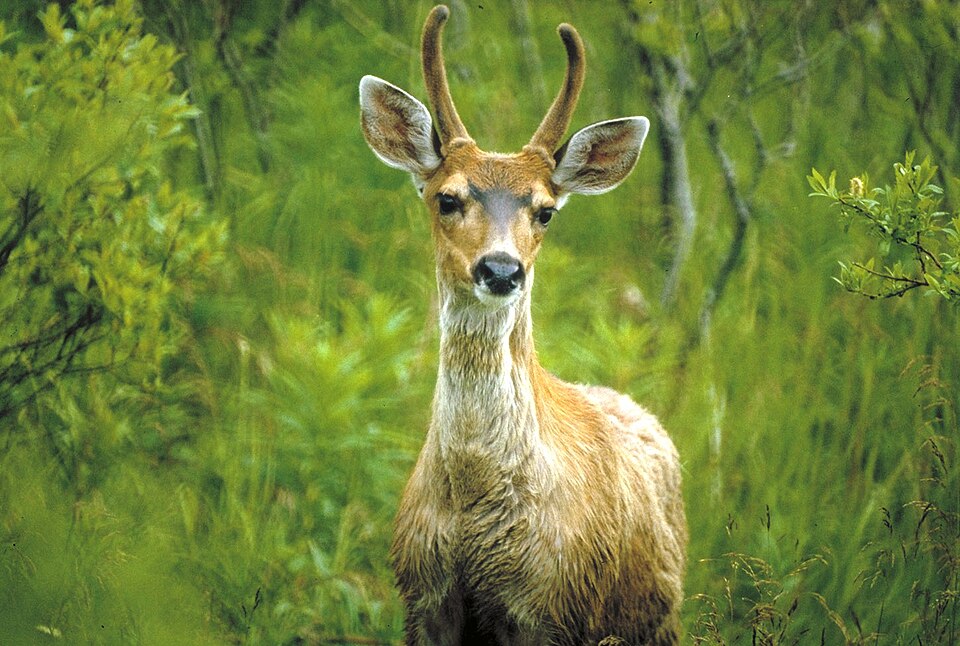
Photo Public domain via Wikimedia Commons
Nutrition per 100g
Πλήρης ανάλυση διατροφής ανά 100g
Its fat is mostly unsaturated.
Per 100 g, Sitka deer also provides 2.9 mg iron, 7.0 mg calcium, 0.200 mg vitamin B1, 0.360 mg vitamin B2 and 6.6 mg vitamin B3.
Research findings
Each finding is a claim distilled from a published study, with an honest verdict on how strongly the wider literature backs it.
-
All 11 abdominal testes examined had no spermatogenesis.
CorroboratedCohort study PMID 16818246 -
Abdominal testes contained abnormalities including carcinoma in situ-like cells, possible precursors of seminoma.
CorroboratedCohort study PMID 16818246 -
Abdominal testes contained carcinoma and adenoma of the rete testis.
CorroboratedCohort study PMID 16818246 -
Cysts were evident within the excurrent ducts.
CorroboratedCohort study PMID 16818246 -
Two of 10 scrotal testes contained abnormalities similar to those in abdominal testes, although spermatogenesis was ongoing.
CorroboratedCohort study PMID 16818246 -
The authors hypothesize that the testis-antler dysgenesis more likely resulted from continuing exposure of pregnant females to an estrogenic environmental agent.
CorroboratedCohort study PMID 16818246 -
The hypothesized estrogenic exposure is proposed to transform testicular cells, affect development of primordial antler pedicles, and block transabdominal descent of fetal testes.
CorroboratedCohort study PMID 16818246 -
A browse such as kelp favored by deer in this locale might carry the putative estrogenic agent.
CorroboratedCohort study PMID 16818246 -
Total monoterpene concentrations were much higher than diterpene concentrations in all plant categories of red cedar.
CorroboratedCohort study PMID 28547441 -
Haida Gwaii red cedar seedlings and old trees had lower monoterpene levels than mainland red cedars.
CorroboratedCohort study PMID 28547441
Showing the 10 most relevant corroborated findings of 168. Search above to explore the rest.
Εργαστηριακές & μηχανιστικές μελέτες (7)
-
Feeding choice experiments tested four hydrocarbon monoterpenes (sabinene, myrcene, alpha-pinene, and d + l-limonene) and one oxygenated monoterpene (alpha,beta-thujone) at their highest natural concentration in western redcedar foliage.
CorroboratedMechanistic PMID 12564790 -
Deer presence resulted in a 30% lower loss of carbon after 1 year.
CorroboratedMechanistic PMID 33098575 -
Deer presence resulted in a 28% lower loss of nitrogen after 1 year.
CorroboratedMechanistic PMID 33098575 -
Deer presence reduced the ability of decomposers to break down carbon but not nitrogen.
CorroboratedMechanistic PMID 33098575 -
Litter placed on an island with deer lost 5% less carbon after 1 year of decomposition than litter on an island without deer.
CorroboratedMechanistic PMID 33098575 -
The loss in decomposer ability to decompose litter in the presence of deer was outweighed by differences in mass loss associated with deer's effect on litter quality.
CorroboratedMechanistic PMID 33098575 -
Feces deposition by deer had significant but minor additional effects on the decomposition process.
CorroboratedMechanistic PMID 33098575
Συνταγές με Sitka deer
Δεν βρέθηκαν ακόμη συνταγές για αυτό το τρόφιμο.
Σχεδιασμένο για διατροφολόγους. Δείτε πώς αναπτύσσει το ιατρείο σας →